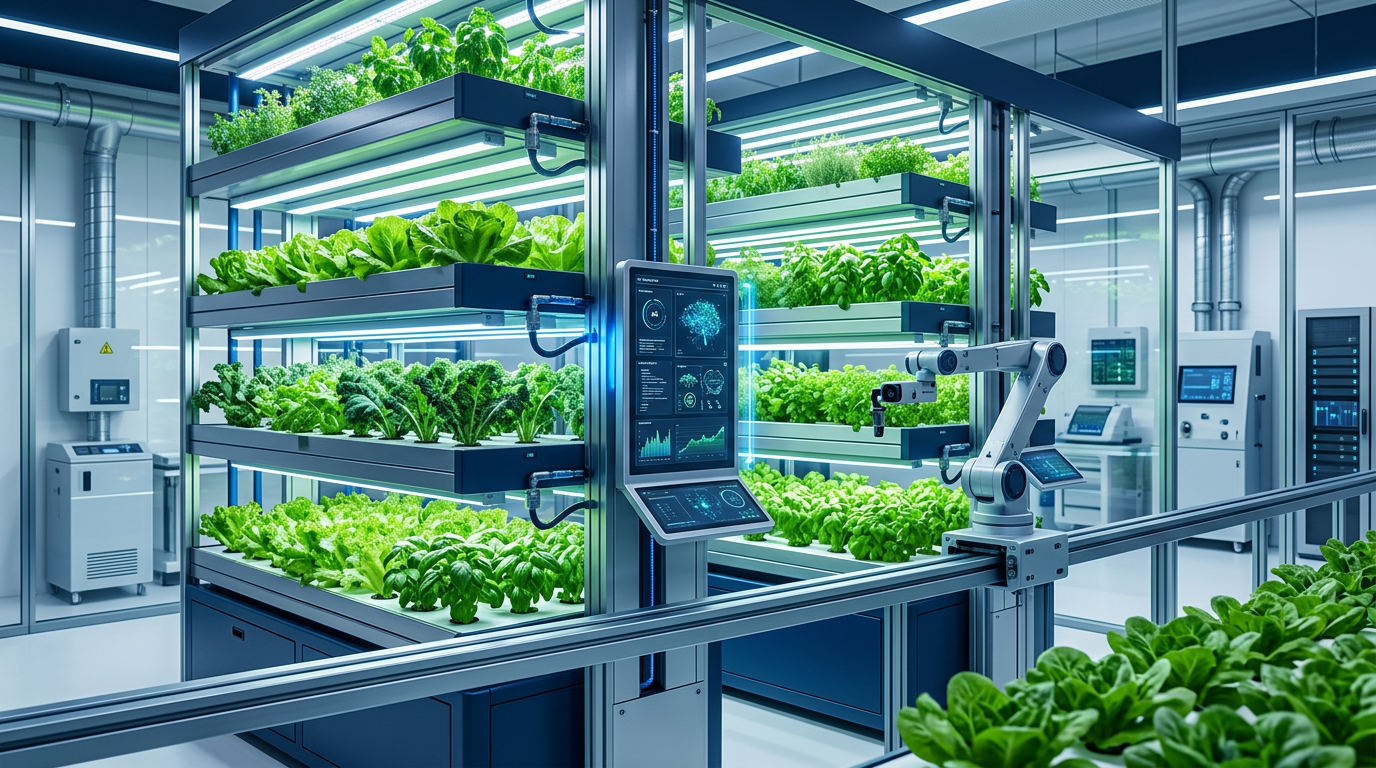
The future of agriculture is taking shape in city skyscrapers, where AI-driven vertical farms are revolutionizing our approach to food production. By 2026, vertical AgTech is no longer a futuristic vision but an unavoidable reality, offering unprecedented investment opportunities for those seeking to reconcile profitability with sustainable impact. Prepare to dive into the heart of this economic and environmental transformation.
AI-driven vertical farms represent a key solution for food sovereignty, increasing yields and reducing environmental footprint. Investments in vertical AgTech 2026 offer significant growth prospects and resilience in the face of climate and logistical challenges.
AgTech 2026: The AI-Driven Vertical Farm Boom
1. The Rise of Vertical AgTech: A Global Imperative
The agricultural landscape is on the verge of a radical transformation, driven by global challenges such as population growth, climate change, and the need for tech-enabled food sovereignty. AI-driven vertical farms are emerging as an innovative and effective response. By 2026, the global vertical farming market is expected to reach over $15 billion, with a compound annual growth rate (CAGR) exceeding 20%. This expansion is fueled by growing demand for fresh, local, and pesticide-free produce, and increased awareness of the environmental impacts of traditional agriculture. Integrating artificial intelligence and automation optimizes every growth parameter—light, water, nutrients, temperature—with unparalleled precision. This ultra-efficient approach reduces water consumption by up to 95% compared to open-field cultivation and eliminates the need for herbicides and pesticides. Savvy investors are turning to these sustainable solutions that promise high and stable returns, while contributing to a more resilient future.
2. AI at the Heart of Vertical Farm Optimization
AI is not just a tool in vertical farms; it is the brain. Machine learning systems analyze terabytes of data collected by sophisticated sensors: soil (or substrate) pH, electrical conductivity, humidity, spectral luminosity, and plant growth. These analyses allow for real-time adjustment of environmental conditions to maximize yields and nutritional quality. For example, algorithms can predict the onset of diseases even before symptoms are visible, optimizing interventions and minimizing losses. Robotic automation, made possible by AI, manages repetitive tasks such as planting, harvesting, and monitoring, drastically reducing labor costs and increasing operational efficiency. This technological ecosystem creates "precise" and "predictive" agriculture, resulting in shorter crop cycles and more abundant and consistent production, regardless of external climate. To delve deeper into these advancements, explore related fields such as Genomics and AI.
The Impact of AI on Resource Consumption
- Water: Up to 95% reduction thanks to closed-loop systems.
- Energy: Optimization of LED lighting and HVAC by predictive algorithms.
- Land Area: Up to 99% more efficient use of space compared to traditional agriculture.
- Pesticides: Near-total elimination thanks to a controlled environment.
3. Competitive Advantages and Resilience for Investors
Urban agriculture investment in vertical farms offers a multitude of benefits for institutional investors. Business models are robust, predictable, and scalable. The urban location of these farms significantly reduces transportation costs, with the supply chain shortened "from producer to consumer" to just a few kilometers. This ensures unparalleled product freshness and a significant reduction in the carbon footprint related to logistics. Furthermore, these systems are inherently resilient to climate shocks, a major asset in a world where extreme weather events are increasingly frequent. Production is unaffected by droughts, floods, or extreme temperatures, ensuring supply security. At Alpha Invest & Securities, we identify opportunities in the Vertical AgTech 2026 sector via CEA Tech Alpha, selecting companies that demonstrate technological leadership and exponential growth potential. Feel free to discover our alternative investment offerings to diversify your capital.
4. Opportunities and Challenges of Vertical Farm Investment by 2026
The enthusiasm surrounding AI-driven vertical farms is palpable, but like any innovative investment, it presents both opportunities and challenges.
Investment Opportunities
- Market Growth: A rapidly expanding sector, with constant innovation.
- ESG (Environmental, Social, and Governance): Strong alignment with sustainable development goals and responsible investment.
- Food Sovereignty: Reduced dependence on imports and strengthened local resilience.
- Portfolio Diversification: Offers low correlation with traditional assets.
Challenges to Monitor
- High Initial Costs: Installing modern vertical farms requires capital-intensive investment.
- Energy Management: Energy consumption, though optimized by AI, remains a key cost factor, highlighting the interest in exploring Long-Duration Energy Storage solutions.
- Technical Expertise: Requires a skilled workforce in AgTech and AI.
- Consumer Acceptance: Though growing, market education is still needed for some segments. We invite you to contact Alpha Invest & Securities to discuss how targeted exposure to this sector can fit into your portfolio strategy and the expected returns.
5. Alpha Invest & Securities' Strategic Role in AgTech
At Alpha Invest & Securities, our expertise in alternative investments ideally positions us to guide our clients in the promising Vertical AgTech 2026 sector. We focus on companies that are at the forefront of innovation, using AI and biotechnologies to maximize efficiency and sustainability. We identify key players who not only generate attractive financial returns but also contribute to improving food sovereignty and environmental protection. Our selection process is rigorous, analyzing business models, management teams, underlying technology, and addressable markets. We look for projects with strong scalability potential and a unique value proposition. By collaborating with us, you benefit from our in-depth market knowledge and our ability to uncover the most relevant opportunities in this disruptive space. Our Investment Expert Team is available to analyze your needs and propose tailor-made strategies.
| Criterion | Advantage of AI Vertical Farm | Impact Level |
|---|---|---|
| Yield | Multiplied by 10-20x compared to soil | High |
| Water | 70-95% reduction | Very High |
| Land | 99% reduction in arable land surface | Very High |
| Pesticides | Elimination or significant reduction | High |
| Freshness | Proximity to consumer | High |
| Resilience | Climate and logistical independence | Very High |
- Ignoring energy consumption: Vertical farms are energy-intensive. Failing to integrate renewable energy solutions or energy optimization (AI) can harm profitability and environmental impact.
- Underestimating technological complexity: This is not traditional agriculture. Neglecting expertise in AI, robotics, and biotechnology will lead to operational failures.
- Forgetting local supply chain challenges: Although reduced, efficient logistics and distribution of perishable products remain crucial.
- Neglecting local market research: Consumer demand and acceptance for vertical farm products must be evaluated.
- Assess market trends: Analyze industry reports on AgTech and vertical farms to understand growth and key players.
- Identify innovative companies: Look for companies integrating AI, robotics, and biotechnologies into their operations.
- Consult alternative investment experts: Speak with specialists who have concrete experience in the AgTech sector for thorough due diligence.
- Define your ESG and financial objectives: Align your investment with economic performance criteria and sustainable impact to maximize returns.
- Grand View Research | https://www.grandviewresearch.com/industry-analysis/vertical-farming-market
- AgFunderNews | https://agfundernews.com/
- USDA National Agricultural Library | https://www.nal.usda.gov/
- Food and Agriculture Organization of the United Nations (FAO) | https://www.fao.org/home/en/
What is an AI-driven vertical farm? It is an agricultural cultivation system where plants are grown in stacked layers in a controlled environment, often in urban settings, and where all growth parameters (light, water, nutrients, temperature) are managed and optimized by artificial intelligence algorithms to maximize efficiency and yields. Why invest in vertical AgTech in 2026? Investing in vertical AgTech in 2026 offers strong growth potential due to increasing global food demand, the need for more sustainable agriculture, and resilience to climate challenges. Furthermore, the integration of AI allows for high and stable yields, and makes a significant contribution to food sovereignty. What are the main challenges for vertical farms? The main challenges include high initial investment costs, energy consumption despite optimizations, the need for advanced technical expertise to manage complex systems (AI, robotics), and sometimes variable consumer acceptance for non-traditionally grown products.
✨ Written with SEO Magic AI — Automated SEO Content Generation