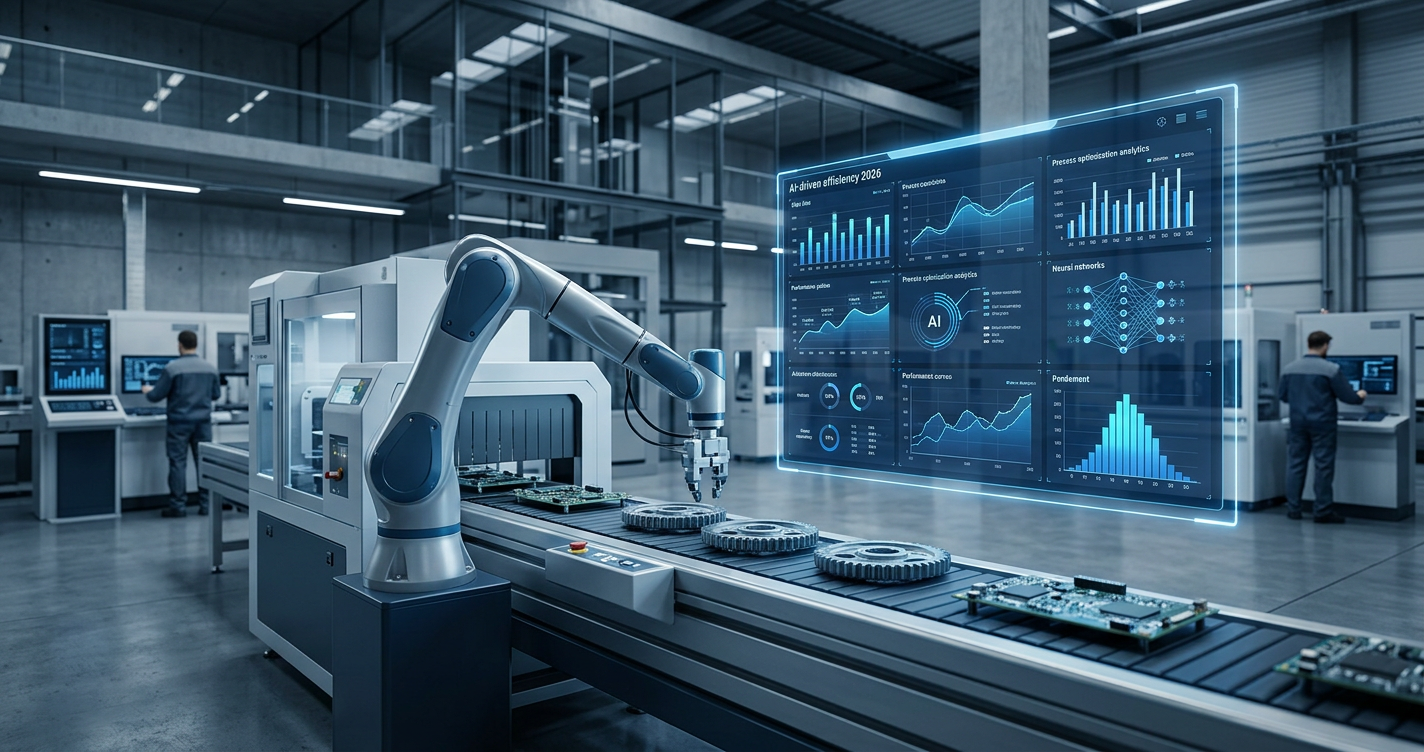
The global industrial landscape is on the cusp of an unprecedented transformation, driven by the synergy between Industrial Automation 2026 and Artificial Intelligence. This convergence not only redefines production processes but also opens up lucrative investment horizons for those who know how to anticipate.
Industrial Automation 2026, boosted by AI, optimizes value chains, prevents breakdowns, and adapts production in real-time, ensuring superior returns. Investors are targeting data-driven solutions to capitalize on the factory of the future and AI smart logistics.
1. The Era of Industrial Automation 2026 and AI: A Profound Revolution
The integration of Artificial Intelligence into industrial automation is no longer a distant prospect but a reality materializing in 2026. This synergy promises to profoundly transform the way manufacturing and logistics companies operate, generating significant increases in productivity and profitability. According to a recent study, the global AI in industry market is expected to reach $22.7 billion by 2027, demonstrating its exponential potential.
Impact on Operational Efficiency
AI allows automated systems to transition from simple execution of predefined tasks to the ability to learn, adapt, and optimize in real time. This includes predictive maintenance, optimization of production flows, intelligent inventory management, and improved product quality. For investors, this means companies with higher margins and better resilience to market fluctuations.
2. 2026 Data-Driven Factory of the Future: The Heart of Innovation
The 2026 factory of the future is an entity where every machine, every sensor, every product generates exploitable data. AI analyzes these massive volumes of data to identify trends, anticipate problems, and propose optimal solutions. This is the principle of "Data Driven Manufacturing."
Process Optimization and Cost Reduction
Thanks to predictive analytics, factories can now anticipate equipment failures, thereby reducing costly downtime. AI algorithms optimize energy consumption, raw material utilization, and even internal transport routes, contributing to significant reductions in operational costs, sometimes up to 20% according to some industry reports. These advancements transform companies into more agile and competitive entities. To better understand how these technologies shape investment, feel free to explore our alternative investment offerings.
3. AI Smart Logistics: The Supply Chain Redesigned
AI smart logistics is an essential pillar of industrial transformation. AI and robotics are revolutionizing warehouse management, goods tracking, and delivery route optimization. Alpha Invest & Securities identifies key players in this rapidly expanding sector.
Increased Efficiency and Responsiveness
AI-based warehouse management systems (WMS) optimize storage and order picking, reducing errors and increasing speed. Autonomous vehicles and drones are increasingly used for internal transport and last-mile delivery. These innovations not only increase efficiency but also improve the supply chain's responsiveness to demand fluctuations. This is an area where alternative investment in cutting-edge technology companies can generate substantial returns.
4. AI Robotics Investment Strategies for 2026
For investors, the era of Industrial Automation 2026 presents unique opportunities. It involves identifying innovative companies that develop concrete applications of AI and AI robotics investment in the manufacturing and logistics sector. Whether in the development of smart sensors, industrial data analytics platforms, or collaborative robotics solutions, the potential is enormous.
Diversification and Long-Term Growth
Investing in this rapidly growing sector offers an excellent opportunity for portfolio diversification and long-term growth. Alpha Invest & Securities, with its recognized expertise and AMF accreditation, assists investors in selecting the best opportunities, particularly in the AI and Biotech 2026 sectors. Our investment expert team is constantly on the lookout for disruptive technologies.
5. Challenges and Prospects of Industry 4.0 2026
Despite the promises, the transition to Industry 4.0 2026 is not without challenges. Cybersecurity, legacy system integration, and workforce training are major issues. However, companies that manage to overcome these obstacles are those that will position themselves as market leaders.
Technology Watch and Adaptation
Constant technology watch and adaptability are crucial. The analysis of industrial big data, big data monetization, and AI infrastructures in Europe are areas to monitor closely. Alpha Invest & Securities leverages a decade of experience in Private Equity and hundreds of deals (900+) to guide you.
| Criterion | Advantage | Level |
|---|---|---|
| Operational Efficiency | Cost reduction, time savings | High |
| Production Precision | Fewer defects, better quality | Very High |
| Industrial Flexibility | Rapid adaptation to demand | High |
| Predictive Maintenance | Reduction of unplanned downtime | High |
- Ignoring the importance of integrating existing systems: Implementing new technologies without a detailed integration plan can create silos and hinder overall efficiency.
- Neglecting cybersecurity: Connected industrial systems are prime targets for cyberattacks; robust protection is essential.
- Underestimating personnel training: The adoption of AI and automation requires upskilling teams to maximize the potential of new technologies.
- Misjudging long-term ROI: Focusing solely on short-term gains can obscure the enormous long-term growth and profitability potential.
- Assess the current state of your production chain and identify bottlenecks suitable for AI automation.
- Seek technological partners offering modular and scalable solutions in AI robotics investment.
- Allocate budgets for training and reskilling personnel for new Industry 4.0 competencies.
- Contact Alpha Invest & Securities for a personalized strategic consultation on alternative investment opportunities in Industrial Automation 2026.
What sectors are most impacted by Industrial Automation 2026? Manufacturing, logistics, agri-food, automotive, and energy are among the sectors most transformed by automation and AI in 2026. How does AI improve maintenance? AI uses sensors and machine learning algorithms to analyze machine data, predict failures before they occur, and optimize maintenance schedules, thereby reducing downtime and costs. What are the risks associated with AI robotics investment? Risks include rapid technological obsolescence, integration complexity, cybersecurity challenges, and the need for significant initial capital. However, with expert management, these risks can be controlled.
✨ Written with SEO Magic AI — Automated SEO content generation