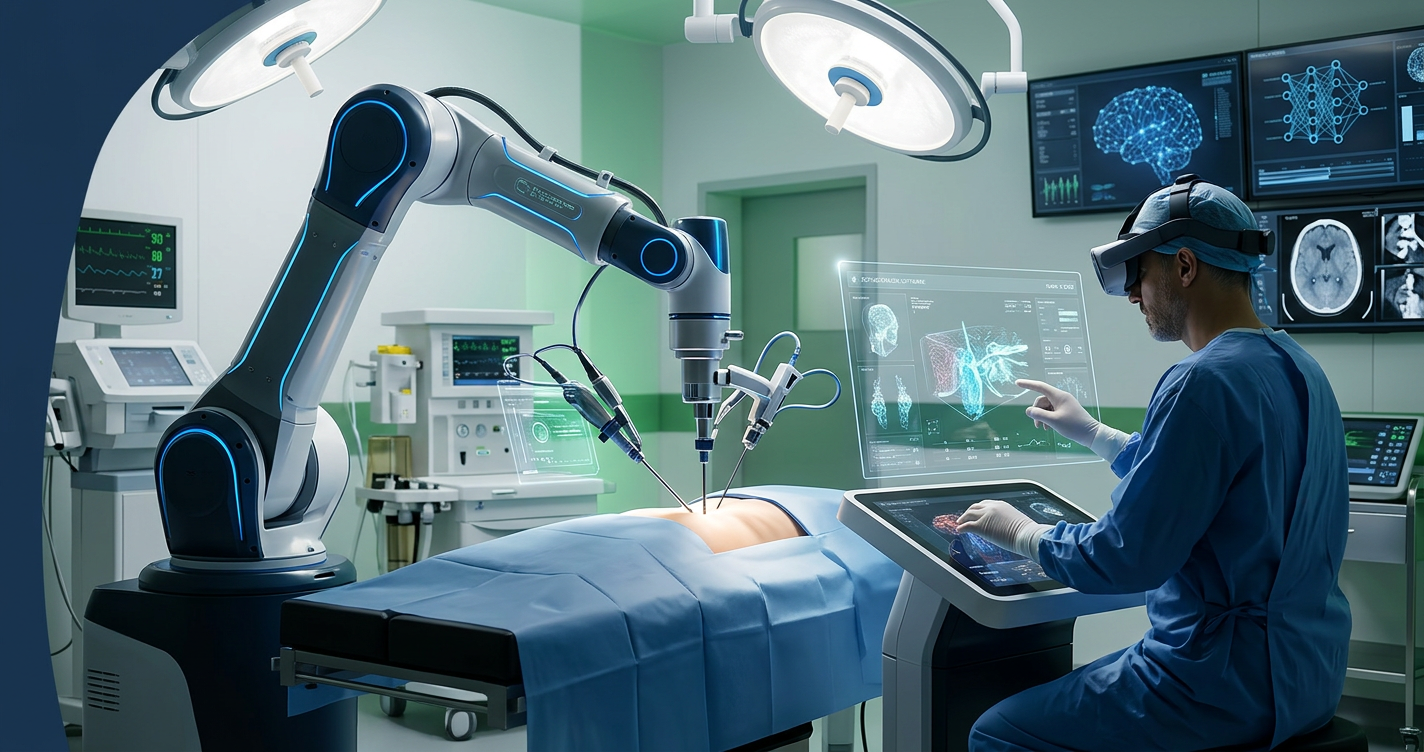
The future of medicine is undergoing a revolution, driven by the integration of cutting-edge technologies. At the heart of this transformation, robotic surgery is emerging as a strategic investment area, promising spectacular advancements in terms of precision, efficiency, and accessibility of care. This article explores the unique opportunities this growing sector offers to astute investors.
Robotic surgery, optimized by artificial intelligence, is a major investment trend for 2026, offering increased precision, reduced risks, and significant growth potential in the MedTech field through continuous technological improvements and the expansion of clinical applications.
Robotic Surgery 2026: AI at the Heart of Alpha Operating Theaters
Medicine is on the cusp of a new era, where the symbiosis between human ingenuity and the computational power of artificial intelligence (AI) redefines healthcare standards. Robotic surgery, in particular, embodies this fusion, radically transforming operating rooms and offering unprecedented prospects for both patients and investors. By 2026, this technology will no longer be a novelty, but an essential component of advanced medicine.
1. The Evolution of AI-Powered Robotic Surgical Assistance
The history of surgical robotics, though relatively young, has been marked by exponential growth. From the first telerobotic systems, we have moved to platforms integrating artificial intelligence for unparalleled autonomy and precision. Robotic surgical assistance 2026 will be characterized by systems capable not only of replicating the surgeon's gestures but also optimizing them through real-time big data analysis.
From Tele-operation to Augmented Intelligence
Early generations of surgical robots, such as the Da Vinci system, demonstrated the immense potential of minimally invasive surgery. Today, AI enriches these platforms by integrating deep learning and computer vision capabilities. This allows robots to interpret complex medical images, plan surgical trajectories with micrometric accuracy, and even anticipate the patient's physiological reactions. This evolution transforms robotics from a mere tool into a true intelligent co-pilot. The figures speak for themselves: the global surgical robotics market, valued at over $6 billion in 2020, is expected to exceed $17 billion by 2028, with a Compound Annual Growth Rate (CAGR) of approximately 14%. This trajectory is largely driven by AI innovation and the expansion of clinical applications.
2. Surgical Precision and Risk Reduction thanks to AI
One of the most significant advantages of integrating AI into robotic surgery is the spectacular increase in surgical precision. AI systems can analyze millions of previous cases, high-resolution 3D scans, and patient physiological data to guide instruments with an accuracy impossible to achieve for the human hand.
Concrete Advantages and Patient Impacts
- Reduction of human errors: AI minimizes variability and fatigue, leading to more stable and reproducible gestures.
- Minimally invasive surgery: Smaller incisions result in less post-operative pain, reduced recovery times, and a lower risk of infection.
- Personalization of interventions: AI enables customized surgical planning, adapted to each patient's specific anatomy and pathology.
- Better clinical outcomes: Studies show that the use of AI-assisted robots can improve surgical success rates and reduce complications. The integration of AI into surgery also opens up prospects for complex areas such as neurosurgery or cardiac surgery, where the margin for error is almost zero.
3. The Impact of 5G on Remote Surgery and Connected Hospitals
The advent of 5G is a major catalyst for the expansion of robotic surgery applications. Its low latency and high bandwidth allow remote surgical interventions to be performed with unprecedented reliability and responsiveness, paving the way for connected hospitals 2026.
Redefining Access to Care
5G remote surgery means an expert surgeon can operate on a patient thousands of kilometers away, guiding a robot with real-time precision. This democratizes access to specialists and advanced surgical techniques, particularly in remote or underserved areas. Alpha Invest & Securities identifies this technological convergence as a primary investment axis, considering the growing needs for medical 5G infrastructure and compatible robotic platforms. MedTech Alpha Invest is positioned to capitalize on these innovations.
4. Investment Opportunities in MedTech Alpha Invest
The MedTech Alpha Invest sector related to robotic surgery and AI offers robust investment opportunities. We target innovative companies developing robotic systems, AI algorithms for surgical planning, computer vision, or virtual/augmented reality training solutions for surgeons. These companies, often fast-growing private equity players, are the pillars of the next generation of healthcare.
Our Strategic Approach
At Alpha Invest & Securities, we have recognized expertise in identifying these technological gems. Our team of experts thoroughly analyzes the market potential, intellectual property, and management team of each company. Our portfolio already includes stakes in pioneering companies in artificial intelligence applied to biotech and MedTech. For example, we closely follow the evolution of generative AI in biotech for drug discovery, a technology that could also power smarter surgical systems. To learn more about our approach and areas of expertise, do not hesitate to discover our alternative investment offerings.
5. Challenges and the Roadmap for 2026
While promising, the expansion of AI-assisted robotic surgery is not without challenges. Issues of regulation, equipment acquisition costs, medical staff training, and ethics surrounding robot autonomy are crucial.
Towards Widespread Adoption
- Regulation and Certification: Clear regulatory frameworks are needed to ensure the safety and effectiveness of new technologies.
- Cost Reduction: Technological innovation should, in the long term, make these systems more affordable and accessible to a greater number of healthcare institutions.
- Training and Acceptance: Continuous surgeon training and public awareness are essential for successful adoption.
- Cybersecurity: Ensuring the security of patient data and robotic systems is an absolute priority. Alpha Invest & Securities collaborates with industry leaders to anticipate and address these challenges, ensuring that our investments are not only profitable but also sustainable and socially responsible.
| Advantage Criterion | Impact Description | Investment Potential |
|---|---|---|
| Surgical Precision | Significant reduction in error margins, millimeter-level gestures | Very High |
| Risk Reduction | Decrease in complications, infections, and recovery time | High |
| Remote Surgery | Extended access to care, democratization of expertise | Very High |
| Operational Efficiency | Optimization of intervention times and resource utilization | High |
| Personalized Care | Treatment adapted to each patient through predictive AI | Very High |
- Investing solely in hardware manufacturers without considering AI software publishers: the true potential lies in the intelligence that powers the robots.
- Neglecting the regulatory and ethical aspects: these factors can hinder or accelerate adoption and profitability.
- Underestimating the importance of connectivity (5G): it is indispensable for the evolution of remote surgery and connected hospitals.
- Evaluate your portfolio: Identify gaps in exposure to disruptive healthcare technologies.
- Research market leaders: Focus on pioneering companies in robotic surgical assistance 2026 and AI Biotech.
- Consult an alternative investment expert: Get an in-depth analysis of MedTech opportunities.
- Schedule an appointment: Discuss personalized investment strategies with Alpha Invest & Securities to integrate these high-potential technologies.
- Markets and Markets - Surgical Robotics Market | https://www.marketsandmarkets.com/Market-Reports/surgical-robotics-market-267253579.html
- Deloitte - 2023 MedTech Industry Outlook | https://www2.deloitte.com/us/en/pages/life-sciences-and-health-care/articles/medtech-industry-outlook.html
- World Health Organization (WHO) - Digital Health | https://www.who.int/health-topics/digital-health#tab=tab_1
What is the main added value of AI in robotic surgery? The main added value of AI is the increase in surgical precision, the personalization of interventions, and the optimization of real-time decisions, reducing errors and improving patient outcomes. Is remote surgery already a reality? Yes, remote surgery is already a technical reality, although its large-scale deployment is still limited by regulatory and infrastructure factors. 5G is a key catalyst for its generalization. Why is Alpha Invest & Securities positioned in this sector? Alpha Invest & Securities, an expert in alternative investments, is positioned in this sector because it represents a convergence of cutting-edge technologies (AI, robotics, 5G) with disruptive growth potential and major societal impacts.
✨ Written with SEO Magic AI — Automated SEO Content Generation