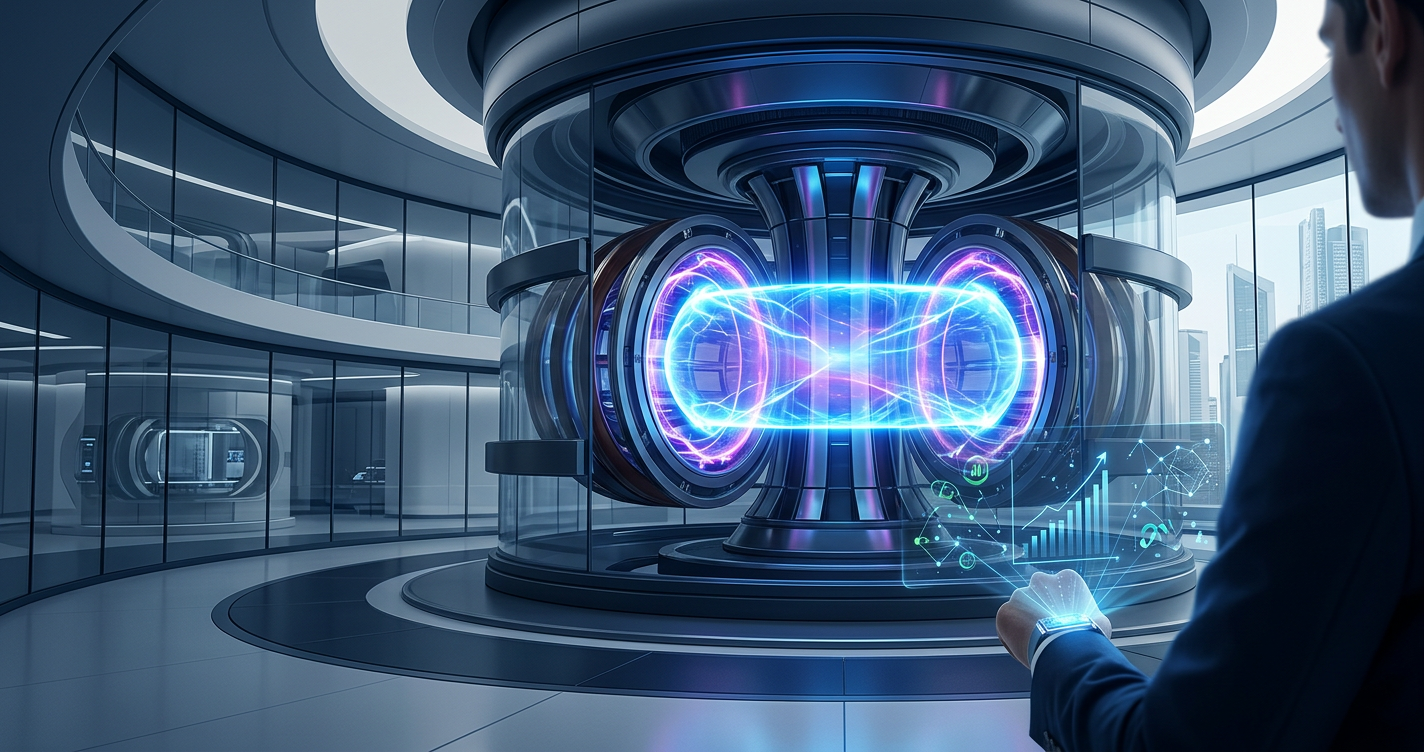
The future of global energy is on the cusp of a revolution. Nuclear fusion, this ancient scientific quest, is about to move from the laboratory to a concrete energy solution, promising a clean, limitless, and safe energy source. For visionary investors, 2026 marks a strategic turning point.
Investing in nuclear fusion before 2026 offers potential for exponential returns thanks to technological advancements and massive support. This carbon-free energy represents a unique opportunity to participate in the global energy transition while diversifying your portfolio with high-growth assets.
1. Nuclear Fusion, Energy of the Future: Why Now?
Nuclear fusion is the process by which two light atomic nuclei combine to form a heavier one, releasing a colossal amount of energy. This is the same mechanism that powers the sun. Unlike nuclear fission, fusion produces little radioactive waste, carries no risk of reactor core meltdown, and uses abundant fuels (deuterium from seawater, tritium). Recent advancements, particularly in high-temperature superconductivity and artificial intelligence, have significantly accelerated the development of fusion reactors. Private companies, backed by billions of dollars in investments, anticipate net energy production demonstrations before the end of the decade. The clear objective for 2026 is to achieve key milestones towards commercialization.
2. Deciphering the Nuclear Fusion Investment Landscape in 2026
The nuclear fusion investment market is bustling. There is a convergence of interests between governments, which seek to achieve their energy transition goals, and private investors, attracted by the disruptive potential of this technology. Several technological models are emerging: magnetic confinement (Tokamaks, Stellators), inertial confinement (lasers), and hybrid approaches. Each technology presents its own challenges and opportunities. In 2023, the sector attracted over $6 billion in private funding, a significant portion of which came from the United States and Europe. Investments are focused on promising startups and research and development projects that are at the forefront of innovation.
3. Alpha Invest & Securities: Your Strategy for European Deeptech Energy
At Alpha Invest & Securities, we are convinced that carbon-free energy 2026 is a major driver of future growth. Our expertise in alternative investments and advanced technologies ideally positions us to identify the gems of European Deeptech Energy. Our approach involves:
- Rigorous selection: Identifying nuclear fusion startups and projects with proprietary technologies and strong management teams.
- Exclusive access: Offering our clients the opportunity to invest in nuclear fusion via private investment vehicles, often inaccessible to the general public.
- In-depth analysis: Evaluating the market potential, technological, and regulatory risks of each project. We anticipate strong growth among European players, fostered by initiatives such as the European Fusion Energy Alliance and dedicated funding programs. Our in-depth knowledge of the European regulatory and technological landscape allows us to guide our investors toward the most promising opportunities. To better understand how we identify these opportunities, feel free to explore our alternative investment offerings.
4. The Advantages of Early Investment in Nuclear Fusion
Investing in nuclear fusion today means positioning oneself in a technology that could very well define the energy landscape for centuries to come. The advantages are numerous:
- Potential for high returns: Disruptive technologies often offer significant return multiples for initial investors.
- Positive environmental impact: Actively participating in the fight against climate change by supporting a clean energy source.
- Portfolio diversification: Adding exposure to a unique asset class, uncorrelated with traditional markets.
- Innovation and exclusivity: Accessing European Deeptech Energy projects at the cutting edge of science and engineering.
- Energy sovereignty: Contributing to global energy independence and geopolitical stability. Projects like ITER in France or private initiatives like Commonwealth Fusion Systems in the United States are leading the way, with major technological milestones expected by 2026.
5. Risks and Strategic Opportunities for Investors
Like any investment in emerging technologies, nuclear fusion involves risks. The main ones are:
- Technological risk: Commercial feasibility on a large scale is not yet fully proven.
- Development timelines: Schedules can be long and subject to delays.
- Regulatory risk: The legislative framework surrounding fusion is still under construction. However, strategic opportunities often overshadow these risks for informed investors. Governments are injecting significant sums, recognizing fusion as a strategic priority. Furthermore, international collaborations and scientific breakthroughs are progressively reducing uncertainty. As experts in alternative strategies, Alpha Invest & Securities helps you navigate this complex landscape, identifying projects with the strongest growth trajectories and most promising teams. Our Investment Expert Team provides in-depth analysis for each opportunity.
6. The Impact of AI and New Technologies on Fusion
The integration of artificial intelligence (AI) and machine learning is rewriting the rules of the game for nuclear fusion. AI enables the optimization of reactor design, precise plasma control, and accelerated analysis of complex experimental data. Sophisticated algorithms are now capable of predicting and preventing plasma instabilities, a major challenge for tokamaks. Combined with advancements in materials science and additive manufacturing (3D printing), AI significantly reduces the costs and development times of prototypes. These technological synergies only accelerate the innovation curve, making the goal of commercial fusion by 2026 increasingly realistic.
| Criterion | Advantage | Level |
|---|---|---|
| Return Potential | Very High | High |
| Environmental Impact | Very Positive | High |
| Technological Innovation | Very Disruptive | High |
| Energy Independence | Strong | High |
| Portfolio Diversification | Very Strong | High |
- Investing without thorough technological and financial due diligence.
- Failing to evaluate the composition and experience of the project's management team.
- Ignoring the evolution of the regulatory framework and government incentives.
- Neglecting sectoral diversification even within advanced technologies.
- Assess your risk appetite and long-term investment objectives.
- Stay informed about the latest advancements in nuclear fusion and Deeptech.
- Contact our experts for a personalized analysis of your portfolio.
- Schedule an appointment to explore specifically selected investment opportunities.
- Fusion Industry Association | https://www.fusionindustryassociation.org/
- ITER | https://www.iter.org/
- U.S. Department of Energy | https://www.energy.gov/fusion
- European Commission | https://energy.ec.europa.eu/topics/nuclear-energy/research-and-innovation/fusion-energy_en
Is nuclear fusion truly commercially feasible? Progress is exponential, with several private companies and government programs aiming for a net energy production demonstration by the end of the decade, making commercialization increasingly probable in the medium term. What are the main risks of such an investment? The major risks include the technological challenge of maintaining a stable and economic fusion reaction, long development cycles, and the absence of a fully defined regulatory framework. How to minimize risks as an investor? Work with specialized financial experts like Alpha Invest & Securities who conduct rigorous due diligence, diversify your investments, and focus on projects with strong partnerships and significant funding.
✨ Written with SEO Magic AI — Automated SEO Content Generation