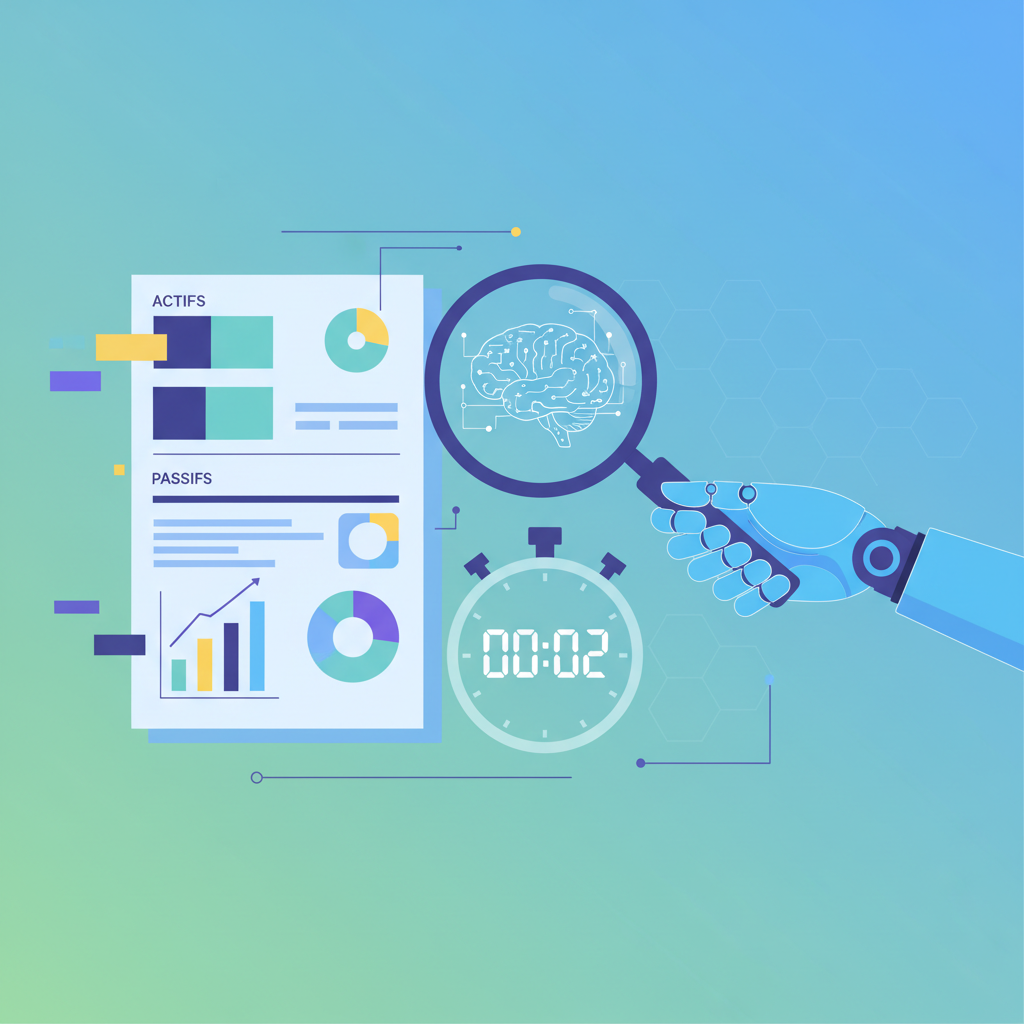
In the fast-paced world of finance, every second counts. Investors are constantly looking for innovative methods to decipher complex financial reports, such as balance sheets. What if Artificial Intelligence (AI) could analyze a balance sheet in a matter of seconds, giving you a decisive competitive edge?
AI, thanks to natural language processing (NLP) and Big Data analysis, is revolutionizing fundamental analysis by rapidly extracting and interpreting key information from balance sheets. It helps identify trends, risks, and investment opportunities, offering precise AI investment scoring and significant time savings for investors.
1. The Challenge of Traditional Fundamental Analysis
Fundamental analysis is the cornerstone of long-term investing. It involves evaluating a company's intrinsic value by examining its financial statements (balance sheets, income statements, cash flow statements), management, industry, and economic outlook. Historically, this process has been incredibly time- and resource-intensive.
- Colossal data volume: Annual reports can contain hundreds of pages.
- Language complexity: Financial jargon and nuances can be difficult to interpret.
- Subjectivity: Data interpretation can vary from one analyst to another.
- Time: It takes hours, sometimes days, to meticulously analyze a single report. These challenges limit investors' ability to analyze a large number of companies quickly and in depth, sometimes leading to less informed decisions.
2. How AI Redefines Balance Sheet Analysis
The emergence of Artificial Intelligence has transformed this approach. AI is no longer just an aid to analysis; it is its primary driver. Thanks to advanced technologies, it can now read, understand, and interpret balance sheets with unparalleled speed and accuracy.
2.1. Natural Language Processing (NLP) in Finance
Natural Language Processing (NLP) is at the heart of this revolution. Sophisticated algorithms can:
- Extract unstructured data: AI identifies key information (figures, descriptive texts, footnotes) from annual reports and transforms it into structured data.
- Analyze sentiment: Beyond numbers, NLP assesses the tone and sentiment of management statements, detecting subtle positive or negative signals.
- Detect anomalies: AI models can spot inconsistencies or unusual patterns in the language used, which could signal hidden risks or opportunities. This ability to "read between the lines" provides investors with a depth of analysis previously unattainable.
3. Big Data and AI Investment Scoring
AI and Big Data are inseparable in this context. AI algorithms don't just analyze an isolated balance sheet; they can process millions of financial documents, economic news, market data, and sector reports simultaneously.
- Massive comparison: AI compares a company's balance sheet to those of its peers, its sector, and historical trends, identifying relative strengths and weaknesses.
- Predictive analysis: By correlating financial data with other indicators (macroeconomic, geopolitical), AI can formulate hypotheses about future performance.
- AI investment scoring: AI assigns an overall score to a company based on a multitude of predefined and weighted criteria. This score may include:
- Financial solidity (debt, liquidity)
- Profitability (margins, ROI)
- Growth (revenues, earnings)
- Specific risks (regulatory, competitive)
- Management quality (NLP sentiment) This AI investment scoring allows investors to sort and filter thousands of companies in record time.
4. Time Savings and Competitive Advantages
The automation of balance sheet analysis by AI offers major strategic advantages:
- Unrivaled speed: AI can analyze a balance sheet in seconds, where a human would take hours. This translates into an ability to react faster to market information.
- Increased productivity: Investors can analyze a much larger volume of companies, expanding their investment universe.
- Reduction of human biases: Analysis is based on objective algorithms, minimizing errors due to fatigue, emotions, or prejudices.
- Early identification of opportunities/risks: AI can detect weak signals or emerging trends that would escape the human eye.
- Strategy optimization: Data and insights generated by AI allow for continuous refinement of investment strategies.
5. Limitations and Precautions to Consider
Despite its impressive capabilities, AI and fundamental analysis are not without limits.
- Data quality: AI is only as good as the data it is trained on. Erroneous or incomplete data will lead to biased analyses.
- Lack of human context: AI excels at quantitative analysis, but it can struggle to grasp complex qualitative nuances (unforeseen technological disruptions, cultural changes).
- Black box: Some AI models, particularly deep neural networks, can be opaque, making it difficult to understand how a specific decision was made.
- Technological dependence: Excessive reliance on AI could atrophy investors' critical analytical skills. It is crucial that AI serves as a tool to amplify human intelligence and not as a total substitute. Human expertise remains indispensable for contextualizing AI results and making the final decision.
| Criterion | Advantage | Level |
|---|---|---|
| Analysis Speed | X1000 | High |
| Data Volume | Unlimited | High |
| Objectivity | Bias Minimization | Medium |
| Risk Detection | Fast & Accurate | High |
| Report Complexity | Simplified | Very High |
- Not verifying the sources of data used by AI, leading to erroneous analyses.
- Completely ignoring qualitative analysis and human context, risking missing crucial non-financial indicators.
- Blindly relying on AI investment scores without understanding the underlying criteria and their limitations.
- Explore financial analysis platforms integrating AI for AI investment scoring.
- Get trained on the basics of AI and fundamental analysis to better interpret automated results.
- Start by using AI as a pre-filtering and signal detection tool, then validate with your own analysis.
- Integrate AI insights into your decision-making process to identify investment opportunities more quickly.
- PwC Global Investor Survey 2023 | https://www.pwc.com/gx/en/investor-relations/global-investor-survey-2023.html
- Deloitte AI Institute – State of AI in the Enterprise, 5th Edition | https://www2.deloitte.com/us/en/insights/focus/ai-and-the-future-of-work/state-of-ai-adoption-enterprise.html
- Forbes – How AI Is Transforming Financial Analysis | https://www.forbes.com/sites/forbestechcouncil/2023/10/25/how-ai-is-transforming-financial-analysis/
Can AI completely replace financial analysts? No, AI is a powerful tool that optimizes and accelerates analysts' work, but it cannot replace human critical thinking, strategic judgment, and understanding of unforeseen contexts. What are the prerequisites for using AI in fundamental analysis? While some platforms are very user-friendly, a basic understanding of financial concepts and fundamental analysis is essential to properly interpret AI results. Is the use of AI for investment accessible to small investors? Yes, more and more platforms and brokers are integrating AI features accessible to retail investors, thus democratizing access to these advanced tools.