In the complex landscape of investment and business acquisition, the Leveraged Buyout (LBO) emerges as an indispensable strategy for many investors. This sophisticated approach enables the acquisition of companies with significant reliance on debt, thereby optimizing return on equity. Understanding LBO functioning is essential for anyone wishing to successfully navigate the intricacies of private equity firms and maximize their growth opportunities.
The LBO, or Leveraged Buyout, is a business acquisition operation predominantly financed by borrowing. Its key principle is financial leverage, where the profitability of equity is amplified through debt, placing the acquired company and its cash flows at the heart of LBO debt repayment.
1. LBO Functioning: Deciphering a Complex Mechanism
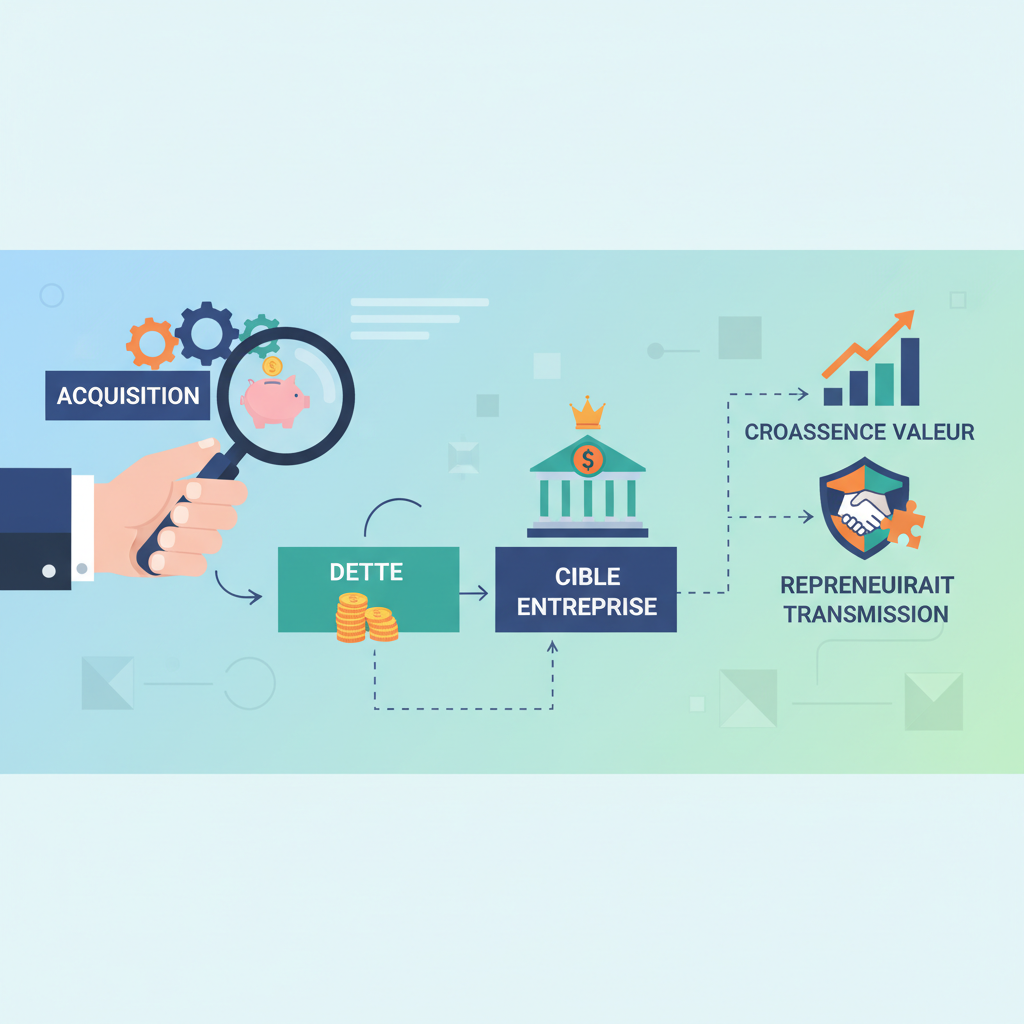
The LBO functioning is based on a seemingly simple principle: the acquisition of a target company (the company to be acquired) by an acquisition holding company (the parent company) specifically created for the operation. This acquisition is predominantly financed by debt contracted by the holding company, whose repayment capacity is supported by the acquired company's future cash flows. This is known as financial leverage, a cornerstone of the LBO.
Key stages of an LBO structure
A typical LBO structure unfolds in several phases:
- Creation of the acquisition holding company: A new legal entity is formed by the acquirers (often private equity firms, managers, or investors).
- Financing the acquisition: The holding company borrows a considerable sum from financial institutions to finance the acquisition of the target company. A portion of the equity is also injected by the acquirers.
- Acquisition of the target company: The holding company uses the funds (debt and equity) to acquire almost all or all of the target company's capital.
- Debt repayment: Profits generated by the acquired company flow up as dividends or financial flows to the holding company, which uses them for LBO debt repayment.
- Resale or exit: After an average period of 5 to 7 years, the holding company (and thus the acquired company) is resold, generating a capital gain for the initial investors.
2. Financial Leverage: The Driving Force of LBO
Financial leverage is the main attraction of LBO for investors. It allows for maximizing the return on invested equity, provided that the cost of debt is lower than the economic profitability of the target company. In other words, if the acquired company generates profits greater than the interest on the loans, the profitability of the equity invested by the private equity firm or other investors will be amplified.
Optimization of invested capital
This effect is twofold:
- Tax optimization: Debt interest is generally deductible from the holding company's taxable income, thereby reducing corporate tax and increasing cash flows available for LBO debt repayment.
- Potential increase in capital gain: The use of debt allows investors to acquire a larger company with less equity, potentially increasing the capital gain upon resale if the company's value has grown.
3. The Acquisition Holding Company: The Heart of the Operation
The acquisition holding company is much more than a mere shell. It is the legal vehicle for the operation, assuming the acquisition debt and holding the shares of the target company. Its structure is crucial for the financial and tax optimization of the LBO setup.
Roles and responsibilities of the holding company
- Debt management: The holding company is the primary borrower and manages LBO debt repayment thanks to the target company's cash flows.
- Strategy and control: It oversees the strategy of the acquired company, implementing performance improvement plans if necessary.
- Tax optimization: Through mechanisms like tax consolidation, the holding company can consolidate results and optimize the overall tax burden.
4. LBO Debt Repayment: A Strategic Challenge
LBO debt repayment is the central challenge of any setup. The target company's ability to generate sufficient cash flows is closely scrutinized by lenders and investors. A solid repayment plan, based on realistic financial forecasts, is imperative.
Key success factors
- Stable cash flows: The target company must exhibit good visibility of its cash flows.
- Proven profitability: Solid historical performance is a key indicator.
- Growth potential: Clear strategies for improving future profitability and cash flows are essential for the private equity firm.
5. The Role of Private Equity Firms in LBO
Private equity firms play a predominant role in LBO operations. They often initiate these setups, identifying undervalued companies or those with strong growth potential. They provide not only the necessary equity but also strategic and operational expertise.
Added value of investment funds
- Capital contribution: Financing the holding company's equity.
- Managerial expertise: Supporting the management team in achieving objectives.
- Strategic advice: Assisting in the implementation of growth, optimization, and integration plans.
- Network: Access to a vast network of contacts and experts.
6. Advantages and Risks for the Investor
LBO functioning presents certain advantages for investors, but it is not without risks.
Advantages for investors
- High profitability: Financial leverage can multiply returns on equity.
- Increased control: The structure generally allows for significant control over the acquired company.
- Tax optimization: The deductibility of debt interest is a major advantage.
- Clear exit strategy: The investment duration is generally defined in advance (5-7 years) with a resale strategy.
Risks to consider
- Debt risk: Too high a level of debt can make the company vulnerable to economic fluctuations.
- Target company performance: If cash flows are insufficient, LBO debt repayment becomes problematic.
- Economic climate: A slowdown can impact the ability to generate revenue.
- Integration and synergy: Failure to realize expected synergies or properly integrate the target.
| Criterion | Advantage | Level |
|---|---|---|
| Fin. Leverage | Return ++ | High |
| Taxation | Optimization ++ | Strong |
| Control | Decision-making + | Important |
| Liquidity | Delayed Exit | Moderate |
- Not accurately evaluating the target company's future cash flows, leading to an inability to manage LBO debt repayment.
- Underestimating the cost of debt or ignoring interest rate variations, which could erode financial leverage.
- Lacking a clear post-acquisition strategy and failing to bring real added value to the acquired company by the acquisition holding company.
- Conduct thorough due diligence on the target company, especially on its historical and forecast cash flows.
- Structure a robust financing plan by balancing equity and debt to optimize financial leverage without over-burdening the company.
- Establish clear governance via the acquisition holding company and define precise strategic objectives for the management team.
- Prepare an exit strategy from the beginning of the operation, considering different options to maximize capital gains for the private equity firm.
- Autorité des Marchés Financiers (AMF) | https://www.amf-france.org/
- France Invest | https://www.franceinvest.eu/
- Banque de France | https://www.banque-france.fr/
What is the main advantage of LBO for an investor? The main advantage is financial leverage, which allows for maximizing the profitability of invested equity through debt financing, by having the cost of debt borne by the cash flows of the acquired company. What is an acquisition holding company in an LBO structure? The acquisition holding company is a company created specifically for the LBO operation. It contracts the debt necessary for the acquisition of the target company and holds its shares, managing LBO debt repayment through dividends or cash flows from the acquired company. How does a private equity firm contribute to an LBO? A private equity firm provides equity, strategic and operational expertise, a network of contacts, and managerial support to optimize the target company's performance and increase its value before resale, thus ensuring the success of LBO functioning.