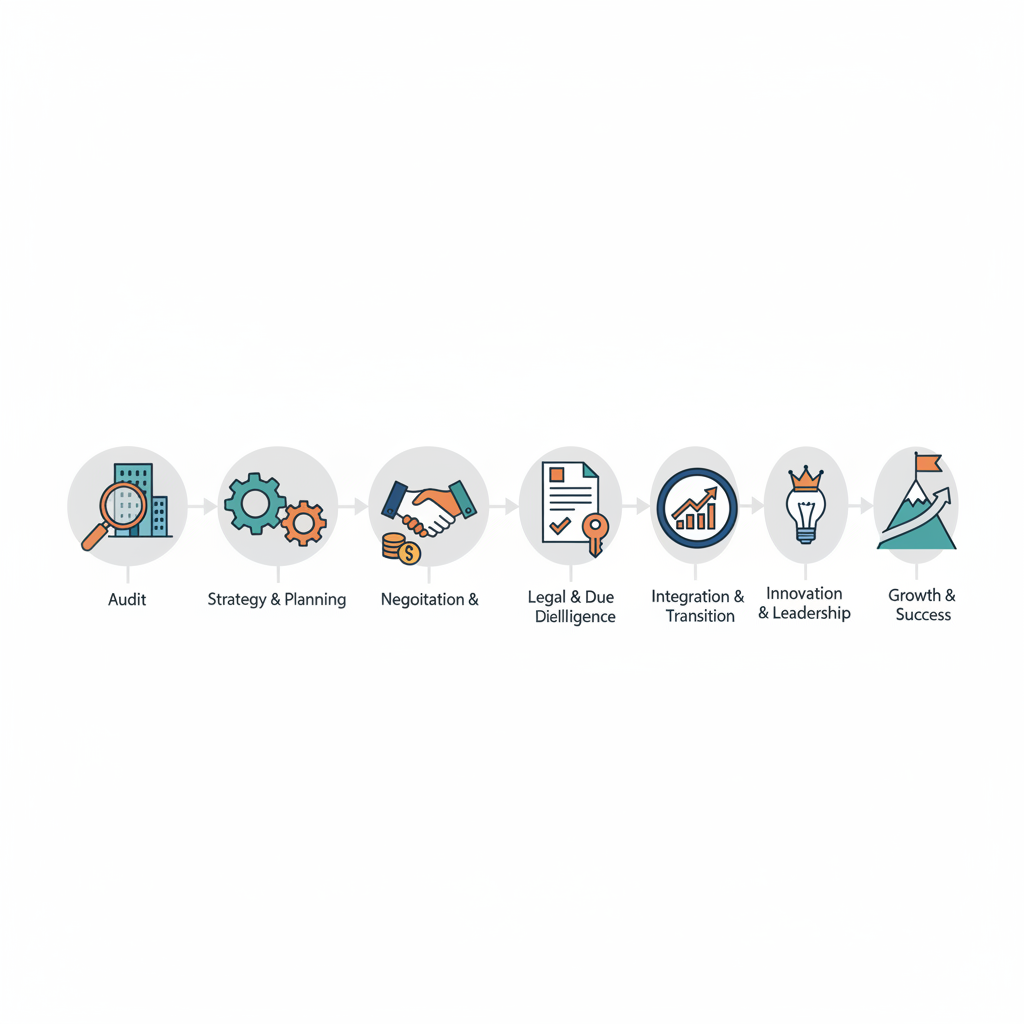
A business acquisition represents a major strategic opportunity for astute investors, enabling them to gain market share, established expertise, and an existing revenue stream. However, this complex process requires method and rigor to turn potential into proven success. Let's explore together the seven fundamental steps that will pave your way to a successful acquisition.
A business acquisition involves meticulous preparation, target research, rigorous acquisition due diligence, fair valuation, negotiation, legal structuring, and a solid takeover business plan to ensure the integration and sustainability of the investment.
Taking Over a Business: The 7 Key Steps to a Successful Acquisition
1. Define Your Acquisition Strategy and Criteria
Before any action, a clear definition of your objectives is imperative. Which industry sector are you targeting? What company sizes interest you? What are your geographical, financial, and management criteria? Solidifying this initial strategy allows for effective filtering of opportunities.
- Market analysis: Study industry trends, competitors, and niche opportunities.
- Financial capacity: Determine your maximum budget and funding sources (equity, loans, investors).
- Management skills: Assess whether your skills match the needs of the target company or if you will need to recruit.
2. Searching for and Selecting Potential Targets
This crucial step involves identifying businesses for sale that align with your strategy. Various channels can be explored to find the perfect match.
- Specialized platforms: Many websites connect sellers and buyers.
- Professional networks: Chartered accountants, business lawyers, investment bankers, and chambers of commerce are valuable sources.
- Direct approach: Identify a company whose model appeals to you and contact them directly, even if it is not officially for sale. Once a list of targets is established, the initial selection will be based on macro criteria to refine the search.
3. Acquisition Due Diligence: Examining the Company from Every Angle
Acquisition due diligence, or due diligence, is the most in-depth and often the longest step. Its purpose is to validate all information provided by the seller and identify potential risks.
Financial and Accounting Due Diligence
- Annual accounts: Analysis of balance sheets, income statements, and appendices over the last 3 to 5 years.
- Cash flows: Verification of cash generation and working capital requirements.
- Debts and off-balance sheet commitments: Identification of hidden liabilities.
Legal, Tax, and Social Due Diligence
- Contracts: Examination of client, supplier, and commercial lease agreements.
- Litigation: Analysis of ongoing or potential disputes.
- Regulation: Compliance with sectoral and environmental standards.
- Personnel: Validation of employment contracts, social compliance.
Operational and Strategic Due Diligence
- Business model: In-depth understanding of the core business, strengths, and weaknesses.
- Customers and market: Analysis of the customer base, competitive position.
- Technologies and patents: Valuation of intangible assets.
4. Valuing the Target Company
Based on the results of the acquisition due diligence, valuation is essential for formulating a fair offer. Several complementary methods exist.
- Multiples method: Application of industry-specific ratios (e.g., revenue multiple, EBITDA multiple).
- Discounted Cash Flow (DCF) method: Projection of the company's future cash flows and discounting them.
- Revalued Net Assets method: Estimation of the value of the company's tangible and intangible assets. This valuation allows for establishing a price range for negotiation.
5. Negotiation and the Memorandum of Understanding
Once the valuation is complete, formal negotiations begin. The goal is to agree on a mutually acceptable price and transactional terms.
- Letter of Intent (LOI): A non-binding document that formalizes the main terms of the agreement (indicative price, conditions precedent).
- Negotiation of clauses: Detailing payment terms, asset and liability guarantees, and the seller's non-compete clause. The memorandum of understanding (or share purchase agreement / asset purchase agreement) is the legally binding document detailing precisely the terms of the transfer.
6. Financing the Acquisition
Structuring the financing is a delicate step that can combine several sources.
- Equity: Personal contribution from the investor.
- Bank loans: Application for credit from financial institutions.
- Investment funds: Involvement of financial partners.
- Love money: Loans or investments from close contacts.
- Vendor credit: The seller grants deferred payment on a portion of the sale price.
7. Post-Acquisition Integration and the Takeover Business Plan
The acquisition is only the beginning. Long-term success will depend on effective integration and a clear strategic vision, formalized in the takeover business plan.
- Integration planning: Strategy for harmonizing cultures, systems, and teams.
- Communication: Informing stakeholders (employees, customers, suppliers) of the transition.
- Performance monitoring: Implementing key indicators to measure the success of integration and the achievement of the takeover business plan objectives. The takeover business plan must include an analysis of the target market, detailed financial projections, a marketing plan, and a human resources management strategy, ensuring the sustainability and growth of the acquired company.
| Acquisition Criterion | Investor Benefit | Complexity Level |
|---|---|---|
| Acquisition Due Diligence | Reduction of hidden risks | High |
| Takeover Business Plan | Clear strategic vision | Medium |
| Target Search | Optimization of opportunities | Medium |
| Consistent Valuation | Fair acquisition price | High |
| Successful Negotiation | Favorable terms | Medium |
- Neglecting acquisition due diligence: Ignoring this step can lead to the acquisition of hidden liabilities or major unanticipated operational problems.
- Underestimating the importance of the takeover business plan: The absence of a clear post-acquisition strategy often leads to integration difficulties and a loss of value.
- Ignoring the human factor: Poor management of key personnel transition can destabilize the company and lead to a loss of vital skills.
- Focusing solely on price: Transaction terms (guarantees, clauses) are as crucial as price for investment security.
- Define precisely your acquirer profile and your target search criteria.
- Contact a chartered accountant or specialized lawyer from the initial stages for legal and financial support.
- Prepare a robust takeover business plan integrating optimistic and pessimistic scenarios.
- Set up a steering committee for post-acquisition integration, including key members of the existing team.
- Bpifrance Création | https://bpifrance-creation.fr/
- CCI France | https://www.cci.fr/
- Agence France Entrepreneur (AFE) | https://www.afecreation.fr/
What is the importance of the memorandum of understanding in a business acquisition? The memorandum of understanding is the key legal document that formalizes all terms of the transfer, including price, payment terms, guarantees, and conditions precedent. It legally binds the parties. How to finance a business acquisition without a significant personal contribution? It is possible to combine several sources: bank loans, recourse to investment funds, vendor credit, or even public aid or honor loans, often in addition to a minimal personal contribution. How long does the business acquisition process typically take? The process can vary considerably, but it generally takes between 6 months and 2 years, depending on the complexity of the company, the speed of the acquisition due diligence, and the negotiation.