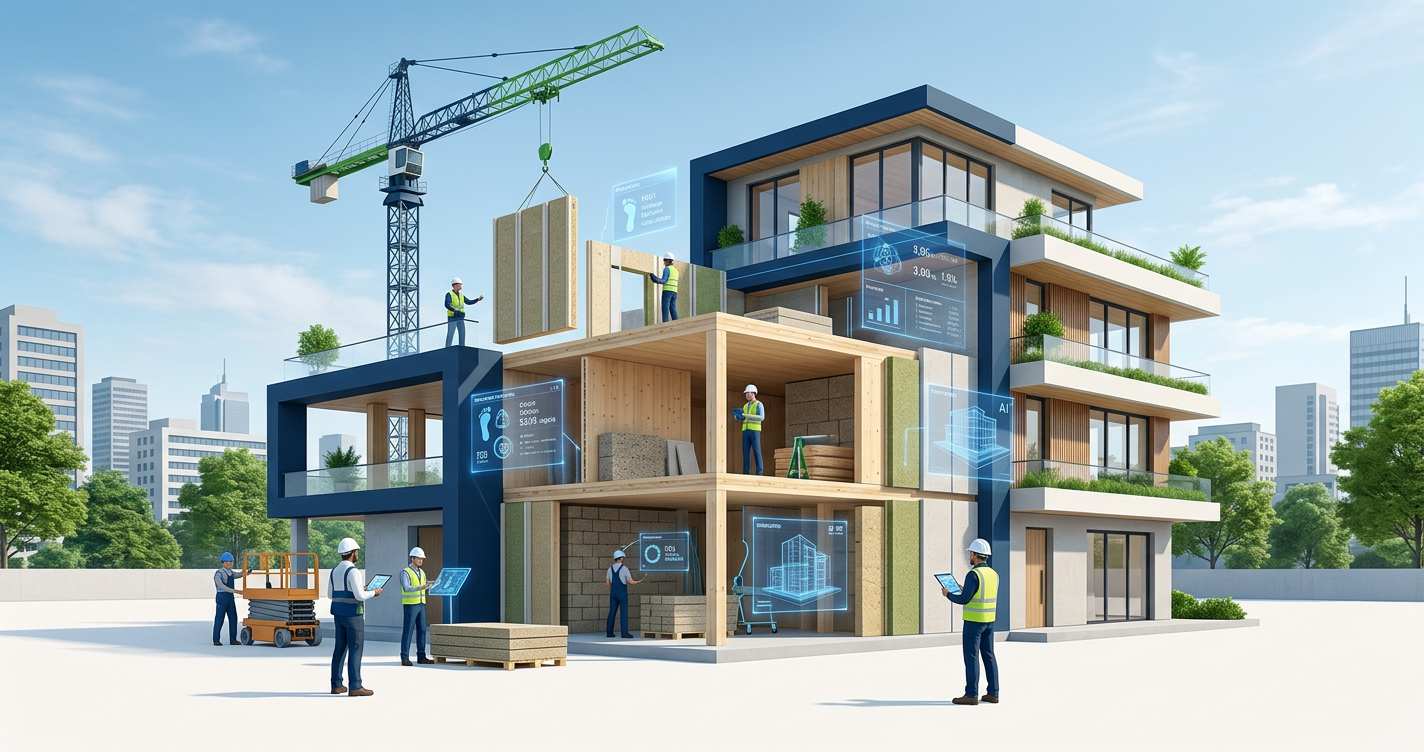
The construction sector, historically a major consumer of resources and carbon emitter, is on the verge of a green revolution. Bio-sourced construction materials 2026 are no longer a marginal alternative, but an essential component of sustainable Alpha real estate. At Alpha Invest & Securities, we identify and structure high-potential investment opportunities in this transition.
Bio-materials represent a major investment opportunity in sustainable real estate, offering profitability and positive environmental impact. They meet growing regulatory requirements and consumer expectations for decarbonized construction 2026, positioning investors at the forefront of a rapidly expanding market.
Bio-Materials 2026: Building the Sustainable Future of Alpha Real Estate
1. The Era of Decarbonized Construction: Why Bio-Materials?
The building sector is responsible for a significant portion of global CO2 emissions and resource consumption. Faced with this reality, the urgency of decarbonized construction 2026 has become a priority. Bio-sourced construction materials 2026 are emerging as a key solution, offering a reduced carbon footprint, improved energy performance, and a positive impact on occupant health. These materials, derived from plant or animal biomass (wood, hemp, straw, cork, flax, etc.), are distinguished by several advantages:
- Low embodied energy : The energy required for their production is significantly lower than that of conventional materials like concrete or steel.
- Carbon storage : During their growth, plants absorb CO2, thus sequestering it in construction materials.
- Superior insulating properties : They improve the thermal and acoustic efficiency of buildings, reducing heating and air conditioning needs.
- Improved indoor air quality : Less emissive in Volatile Organic Compounds (VOCs), they contribute to healthier environments. Environmental regulations, such as RE2020 in France, reinforce this dynamic by promoting the use of low-carbon impact materials. For investors, understanding these developments is crucial.
2. Hempcrete Tech: A Structural Revolution
Among bio-sourced construction materials 2026, hempcrete tech positions itself as a major innovator. It is not concrete in the traditional sense (no cement), but a mixture of hemp shiv (the woody core of the hemp plant) and a lime-based mineral binder. Its properties are remarkable:
- Thermal and hygrometric insulation : It naturally regulates temperature and humidity, offering optimal comfort.
- Lightness and workability : Facilitates construction and reduces structural load.
- Fire and pest resistance : Intrinsic qualities that surpass many traditional materials.
- CO2 storage capacity : Hemp absorbs significant amounts of CO2 during its growth. Technological advances now make it possible to produce prefabricated hemp blocks or to use the material as insulating infill, optimizing construction costs and deadlines. We anticipate exponential growth in projects integrating hempcrete tech in the coming years, offering attractive returns for savvy investors looking to place their capital in sustainable Alpha real estate. To explore other innovations in smart construction, you might be interested in the potential of Digital Twins Cities 2026.
3. The Impact of Bio-Materials on Real Estate Valuation and Investment
The adoption of bio-materials is not just a matter of environmental ethics; it is also a substantial lever for the valuation of sustainable Alpha real estate.
- Reduced operating costs : Thanks to better insulation, buildings made with bio-materials result in lower energy bills, a strong argument for tenants and buyers.
- Certification and labeling : Buildings constructed with bio-sourced materials more easily obtain environmental certifications (HQE, BREEAM, LEED), increasing their attractiveness and market value.
- Brand image and CSR : For companies, investing in green building investment through bio-material projects strengthens their image and meets their Corporate Social Responsibility (CSR) objectives.
- Asset longevity : These buildings are better adapted to future regulations, ensuring better investment longevity. Our experts at Alpha Invest & Securities, with over 15 years of experience in alternative strategies, identify innovative projects that guarantee not only solid profitability but also a measurable positive impact. Our alternative investment offerings are designed to target these growth opportunities.
4. Challenges and Opportunities in an Evolving Market
The bio-materials market is experiencing rapid growth but faces certain challenges.
- Supply chain : The structuring of agricultural and industrial sectors for these materials is underway.
- Standardization and certification : Ensuring product compliance and performance on a large scale is essential for mass adoption.
- Professional training : The implementation techniques for bio-materials require specific skills. However, these challenges also create opportunities for innovation and investment. Companies that invest in research and development of new manufacturing processes, or in the training of craftspeople, are positioned to capture a significant share of this rapidly expanding market. Alternative investment in this sector is promising, especially as public policy support and financial incentives continue to grow. For investors seeking to diversify their portfolios in future-oriented areas, sustainable Alpha real estate represents a strategic path.
5. Alpha Invest & Securities: Your Partner for Sustainable Real Estate
At Alpha Invest & Securities, we are convinced that the future of investment lies in the ability to combine financial performance with positive impact. Our expertise in Private Equity and alternative strategies allows us to unearth unique opportunities in bio-materials and sustainable real estate. We provide you with:
- A team of experts with in-depth knowledge of emerging markets and cutting-edge technologies. Our Team of Investment Experts is ready to assist you.
- A rigorous selection of innovative projects with high growth potential, accredited by the AMF.
- Structured investment solutions to maximize your return while addressing environmental issues.
- An extensive network of decarbonized construction 2026 players, from startups to large corporations. With a portfolio of 120 million euros under management and more than 50 deals completed, we are the trusted partner to transform environmental challenges into lucrative investment opportunities.
| Criterion | Advantage | Level |
|---|---|---|
| Embodied Energy | Significant reduction | High |
| Carbon Storage | CO2 capture | High |
| Energy Performance | Superior insulation | High |
| Indoor Air Quality | Low VOC emission | High |
| Market Valuation | Ecological certifications | High |
- Common mistake 1 to absolutely avoid: Not considering the local supply chain for bio-materials, which can negate some of the ecological and economic benefits.
- Common mistake 2 and why: Underestimating the importance of training craftspeople in the implementation of these specific materials, leading to defects or construction delays.
- Common mistake 3 with consequences: Ignoring available tax incentives and government subsidies for sustainable construction, missing out on significant financial levers to optimize returns.
- First immediate actionable step: Evaluate investment opportunities in specialized funds for sustainable Alpha real estate and bio-materials.
- Second concrete step: Consult our experts for a personalized analysis of relevant projects for your portfolio.
- Third measurable step: Explore case studies of successful projects integrating hempcrete tech or other innovative materials.
- Fourth step with expected outcome: Position your portfolio in a high-growth market, reconciling profitability and positive environmental impact.
- France Stratégie | https://www.strategie.gouv.fr/publications/batiment-carbone
- ADEME | https://www.ademe.fr/expertises/batiment/passer-a-laction/batiments-neufs/materiaux-biosources-geosources
What is a bio-sourced material in construction? A bio-sourced material is a material derived from plant (wood, hemp, straw, cork, etc.) or animal biomass, used in construction for its ecological and performance properties, contributing to reducing the carbon footprint of buildings. Is hempcrete structural? Hempcrete is primarily used as an insulating and infill material, offering excellent thermal and hygrometric performance. Although it has some load-bearing capacity, it is generally used in combination with a traditional load-bearing frame (wood or concrete). What are the financial advantages of investing in bio-material real estate? Financial advantages include better asset valuation through environmental certifications, reduced operating costs (energy), improved rental attractiveness, and better investment longevity in the face of increasing environmental regulations.
✨ Written with SEO Magic AI — Automated SEO content generation