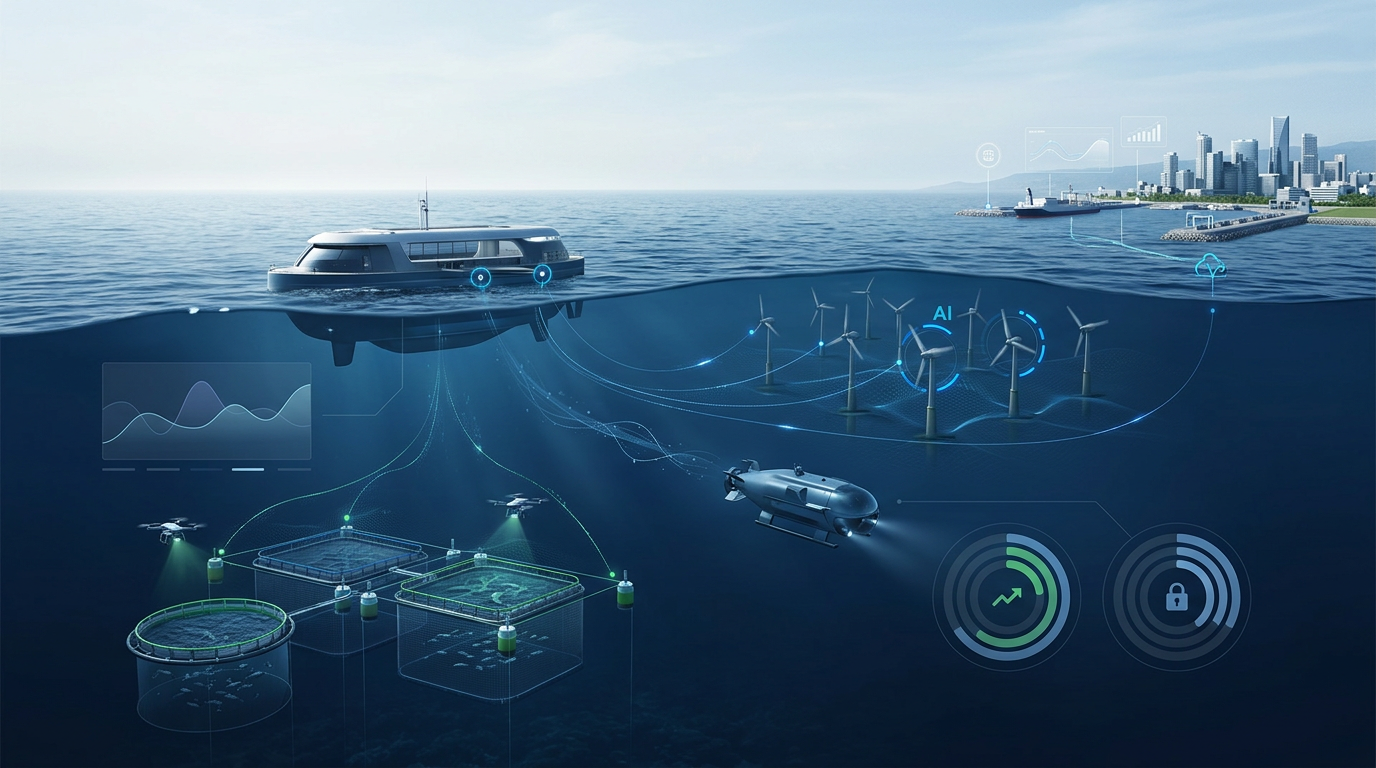
The future of investment lies beneath our feet, or rather, beneath the ocean's surface. The Blue Economy is emerging as a major growth driver, offering unprecedented opportunities for astute investors. In 2026, this sector represents not only considerable financial potential but also a commitment to sustainability.
The Blue Economy Investment 2026 offers sustainable growth via EU marine energy, AI aquaculture 2026, and other innovations. It is a key sector for diversifying one's portfolio and investing in the planet's future.
1. Understanding the Blue Economy: A Horizon of Strategic Investments
The Blue Economy is much more than a simple concept; it encompasses all economic activities related to oceans, seas, and coasts that contribute to the health of marine ecosystems. Estimated at $2.5 trillion annually globally, it directly supports over 30 million jobs. In 2026, the focus is on a sustainable approach, reconciling profit with resource preservation. Key sectors include marine energy, blue biotechnology, sustainable aquaculture, responsible coastal and marine tourism, and ecological maritime transport. It is crucial for investors to understand this duality to grasp the full extent of the opportunities.
2. Renewable Marine Energies: The European Ocean Potential
Europe is at the forefront of the energy transition, and EU marine energies are an essential pillar. Technologies such as floating offshore wind, wave energy, and tidal energy are experiencing spectacular development. The International Energy Agency (IEA) predicts that global offshore wind power capacity could reach 228 GW by 2030, with a significant share in Europe. Investing in this area means supporting energy independence and generating long-term returns. Alpha Invest & Securities identifies projects with strong growth potential, particularly those integrating innovative solutions for energy production and storage. For increased electrical sovereignty, explore the detailed article on Energy Storage 2026: EU Electrical Sovereignty.
3. Smart Aquaculture (AI) in 2026: Feeding the Future
AI aquaculture 2026 represents a revolution in marine food production. Faced with overfishing and increasing demand for protein, sustainable aquaculture, optimized by artificial intelligence, IoT, and robotics, offers a promising solution. AI-driven systems monitor water quality, fish feeding, and detect diseases, increasing farming efficiency and reducing their environmental impact. The global aquaculture market is expected to exceed $300 billion in a few years. Investments in companies developing these technologies or next-generation aquaculture farms are key. This sector is part of a growth and responsibility dynamic, similar to the innovations observed in agroforestry with the article Agroforestry 2026: Land Asset Reimagined by AI.
4. Blue Biotechnologies: Innovation from the Deep Sea
Blue biotechnologies leverage marine biodiversity to develop new products and applications in various fields such as pharmacology, cosmetics, agri-food, and bioenergy. Oceans harbor an inexhaustible source of bioactive compounds offering unique properties. The global marine biotechnology market is projected to exceed $100 billion by 2030. It is a fertile ground for innovation and high-impact investments. Our team of experts analyzes startups and established companies that are at the forefront of this research.
5. Measuring Return on Investment in the Sustainable Blue Economy
Alpha Ocean Investing requires rigorous evaluation of returns while ensuring a positive environmental impact. The growth of the sustainable Blue Economy is not only measured in terms of profit but also by ESG (Environmental, Social, Governance) indicators. For example, for marine energies, ROI can be linked to the reduction of CO2 emissions and the creation of local jobs. For AI aquaculture, it involves increased productivity with minimized water and feed consumption. Alpha Invest & Securities integrates these criteria into its analyses to select the most promising opportunities aligned with its clients' values. Discover our alternative investment offerings for a comprehensive approach.
6. Challenges and Prospects of the Blue Economy in 2026
Despite its potential, the Blue Economy faces challenges: high initial investments, regulatory complexity, and the need for robust technologies. However, political momentum, notably through the European Green Deal, and rapid technological innovation open new avenues. Prospects for 2026 and beyond are excellent, with growing global awareness of the importance of oceans for our planet. Governments and financial institutions are increasingly recognizing the strategic value of investments in the sustainable marine economy.
| Criterion | Advantage | Level |
|---|---|---|
| Growth Potential | High | ★★★★★ |
| Environmental Impact | Positive | ★★★★☆ |
| Portfolio Diversification | Excellent | ★★★★☆ |
| Market Resilience | Strong | ★★★★☆ |
- Ignoring the sustainability aspect: Purely extractive investments without consideration for the marine ecosystem are to be avoided, as they expose themselves to increasing regulatory and reputational risks.
- Neglecting sectoral diversification: Focusing on a single segment of the Blue Economy can increase risks. A diversified approach is preferable to capture overall growth.
- Underestimating technological complexity: Blue Economy projects are often at the technological forefront. Thorough due diligence of innovations is essential.
- Evaluate your investment objectives and risk appetite in the blue economy sector.
- Research key sub-sectors: marine energies, sustainable aquaculture, blue biotechnologies.
- Contact Alpha Invest & Securities for a personalized consultation and to discover opportunities tailored to your portfolio.
- Integrate strong ESG criteria for investments that are both profitable and responsible.
- European Commission | https://ec.europa.eu/info/topics/maritime-affairs-and-fisheries_fr
- International Energy Agency (IEA) | https://www.iea.org
- World Bank Group | https://www.worldbank.org/en/topic/blue-economy
- United Nations (UN) | https://www.un.org/sustainabledevelopment/oceans/
What exactly is the Blue Economy? The Blue Economy encompasses all economic activities that use oceans, seas, and coasts sustainably for growth and human well-being. Why invest in the Blue Economy in 2026? The year 2026 marks an acceleration of investments in this sector, driven by the need for energy transition, food security, and technological innovation, offering attractive returns and a positive impact. What are the risks associated with investing in this sector? Risks include technological challenges, regulatory uncertainties, high initial investment costs, and environmental hazards. In-depth expertise is essential to mitigate these risks.
✨ Written with SEO Magic AI — Automated SEO Content Generation