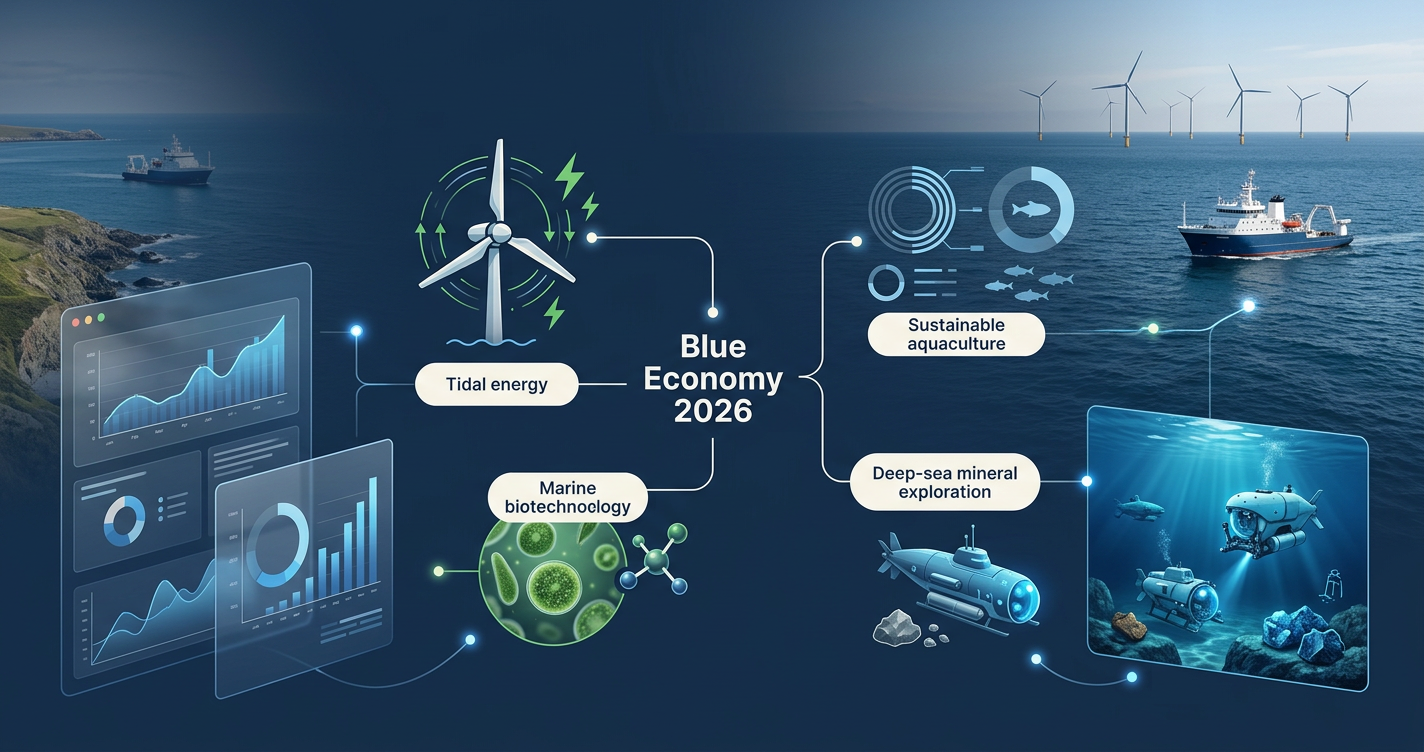
The ocean, a vital ecosystem and an invaluable source of resources, is at the heart of a new era of investment opportunities: the Blue Economy. In 2026, this sector is poised to catalyze sustainable economic growth, combining technological innovation with environmental imperatives. Alpha Invest & Securities guides you through this expanding market, where profitability meets responsibility.
The Blue Economy 2026 represents a strategic alternative investment market, estimated at several trillion, focused on the sustainable exploitation of ocean resources through innovation (marine energies, AI aquaculture, biotechnologies). Investing in this domain means combining attractive returns with a positive environmental impact.
Blue Economy 2026: Future Investments for our Oceans
Oceans cover more than 70% of the Earth's surface and represent an immense, often underestimated, economic potential. The Blue Economy encompasses all maritime and coastal economic activities that contribute to the production of goods and services, while ensuring the health of marine ecosystems. With an estimated value of over 2.5 trillion US dollars per year, and the creation of over 30 million global jobs, this sector offers exceptional alternative investment prospects for discerning investors.
1. Understanding the Blue Economy: A Pillar of Sustainable Growth
The Blue Economy is not limited to fishing and maritime transport. It encompasses a much broader spectrum of activities, all oriented towards sustainability and innovation. It is about reconciling economic development with the preservation of marine resources. Technological innovations, particularly artificial intelligence and biotechnologies, are major catalysts for this transformation.
Key Sectors of the Blue Economy
- Marine Renewable Energies (MRE): Exploitation of wave, current, tidal, and temperature differential energy.
- Sustainable Aquaculture: Environmentally friendly marine food production, often AI-assisted.
- Marine Biotechnologies: Development of pharmaceutical, cosmetic, and industrial products from ocean resources.
- Sustainable Coastal and Maritime Tourism: Low environmental impact leisure activities.
- Ecological Maritime Transport: Innovations to reduce the carbon footprint of marine logistics.
- Management and Protection of Marine Ecosystems: Technologies for monitoring, depollution, and habitat restoration.
2. Hydrokinetic Energy 2026: The Power of Ocean Currents
Hydrokinetic Energy 2026 positions itself as a major component of marine renewable energies. It harnesses the kinetic energy of ocean currents to produce electricity continuously and predictably. Unlike wind or solar power, the hydrokinetic resource is less susceptible to weather fluctuations and offers a higher capacity factor. In 2026, advancements in turbine design, corrosion-resistant materials, and grid integration will make hydrokinetic energy a competitive power source. Large-scale pilot projects are already underway, and alternative investment funds are actively targeting this segment. At Alpha Invest & Securities, we identify opportunities in companies developing breakthrough technologies capable of maximizing energy yield while minimizing ecological impact.
3. Sustainable AI Aquaculture 2026: Intelligently Feeding the World
With global population growth and the depletion of wild fish stocks, Sustainable AI Aquaculture 2026 is a crucial response for food security. The integration of artificial intelligence transforms traditional aquaculture into a more efficient, cleaner, and animal-friendly production system. AI enables precise water quality monitoring, optimization of fish feeding, early disease detection, and automated farm management. These innovations reduce water consumption, limit antibiotic use, and improve yields. Investment in these technologies offers a dual benefit: a positive environmental impact and solid financial returns. Companies specializing in intelligent monitoring and underwater robotics for aquaculture represent prime investment targets for our clients.
4. Ocean Protection Investment: An Imperative and an Opportunity
Ocean protection is not just an environmental responsibility; it is also a rapidly expanding investment domain. Technologies aimed at reducing plastic pollution, restoring coral reefs, or monitoring protected marine areas are attracting increasing capital. These initiatives include innovative solutions such as underwater drones for seabed mapping, microplastic capture systems, and depollution biotechnologies. Companies that develop these solutions are part of a sustainability approach and often benefit from public and private funding focused on social and environmental impact. The demand for these technologies is global, offering significant growth prospects. For our clients seeking to align their values with their investments, this segment offers unique opportunities within our alternative investment offerings.
5. Market Perspectives and Challenges for the Blue Economy in 2026
The Blue Economy market is dynamic but not without challenges. Environmental regulation, ecosystem protection, and the need for substantial initial investments can sometimes hinder development. However, the imperative to find sustainable solutions for energy, food, and planetary preservation stimulates innovation and capital inflow. In 2026, we anticipate an acceleration of investments in "green" port infrastructure, decarbonized propulsion vessels, and offshore aquaculture farms integrating AI. Advances in composite materials and underwater robotics will also open new avenues for respectful exploration and exploitation of resources. Investors looking for returns in high-potential sectors can discover our alternative investment offerings that specifically include these areas. We are accredited by the AMF and rely on a team of financial experts with over 15 years of experience in identifying and structuring innovative deals, ensuring robust and compliant investment strategies. To learn more about our approach, we invite you to consult the page dedicated to Our Investment Experts Team.
| Investment Criterion | Key Advantage | Potential (1-5) |
|---|---|---|
| Hydrokinetic Energy 2026 | Stability & Predictability | 4 |
| Sustainable AI Aquaculture 2026 | Food Security & Efficiency | 5 |
| Ocean Protection Investment | Environmental Impact & Innovation | 4 |
| Marine Biotechnologies | New Medicines & Materials | 4 |
| Green Maritime Transport | Carbon Reduction & Compliance | 3 |
- Failure to assess real environmental impact: Investing without thorough due diligence on a project's sustainability can lead to reputational risks and poor long-term performance.
- Ignoring the regulatory framework: The Blue Economy is subject to complex maritime and environmental regulations that can vary significantly and impact project viability.
- Underestimating initial capital needs: Many Blue Economy projects, especially in marine energies, require heavy and long-to-amortize investments.
- Evaluate your current portfolio and identify your investment objectives related to sustainability.
- Learn about emerging Blue Economy technologies, such as those related to Medical Internet of Things 2026 or Industrial Predictive Maintenance 2026, which may have marine applications.
- Schedule an appointment with our specialists to analyze specific opportunities tailored to your investor profile.
- Integrate responsible and high-performing investment solutions into your long-term strategy for lasting impact.
- United Nations | https://www.un.org/sustainabledevelopment/oceans/
- European Union | https://ec.europa.eu/oceans-and-fisheries/ocean/blue-economy_fr
- The World Bank | https://www.worldbank.org/en/topic/blue-economy
What distinguishes the Blue Economy from traditional maritime investments? The Blue Economy emphasizes the sustainable exploitation of marine resources, ecosystem preservation, and innovation, whereas traditional maritime investments are not necessarily focused on sustainability. What are the main risks associated with investments in the Blue Economy? Risks include regulatory complexity, technological constraints (corrosive marine environment), high initial financing challenges, and potential impacts of climate change on marine ecosystems. How does Alpha Invest & Securities identify the best opportunities in the Blue Economy? Our approach is based on in-depth sectoral expertise, rigorous analysis of technological innovations (AI, biotech), and strict evaluation of environmental impact, selecting projects with high growth potential and sustainability.
✨ Written with SEO Magic AI — Automated SEO Content Generation