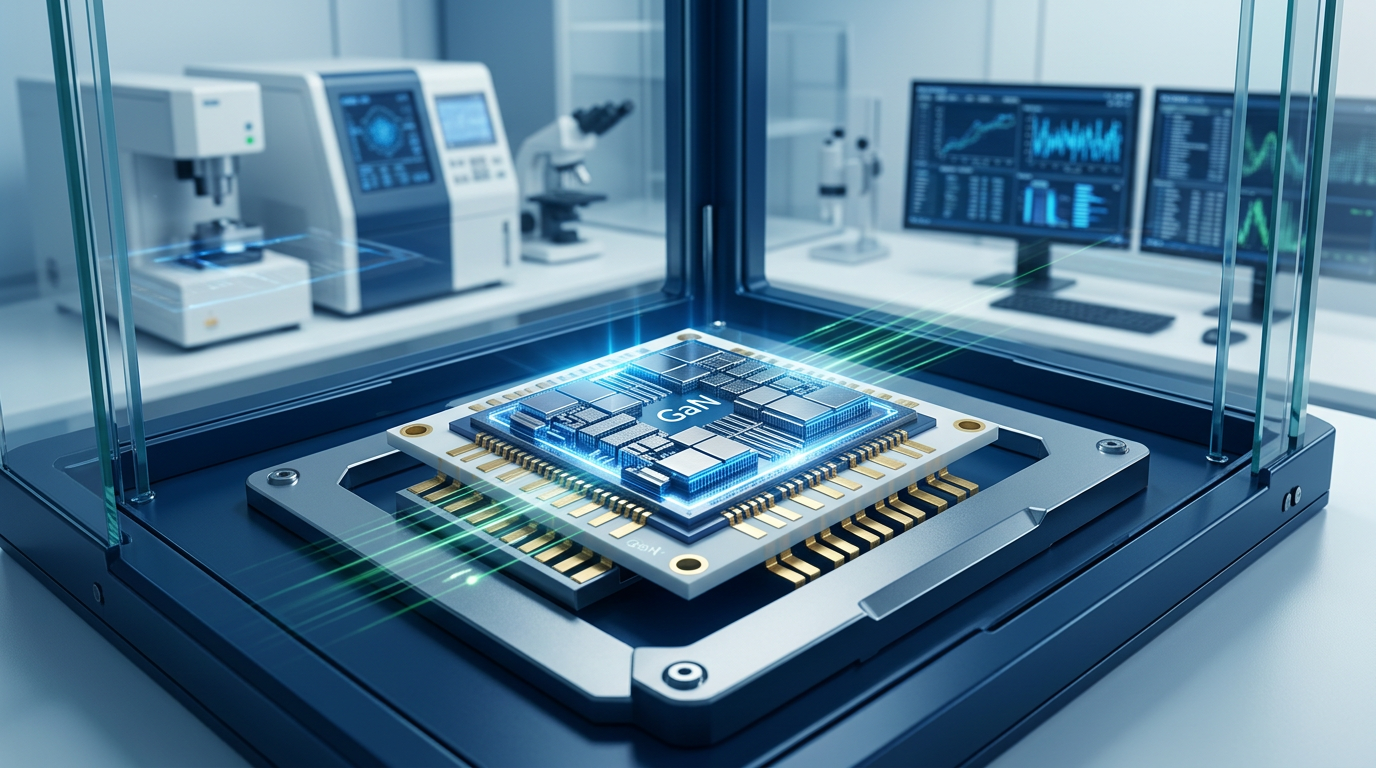
The world of technology is constantly evolving, and at the heart of this transformation are discrete but fundamental innovations. Gallium nitride (GaN) chips represent one of these major advancements, promising to redefine energy efficiency across a multitude of sectors. For astute investors, understanding this technology is essential to anticipate future growth drivers.
Gallium nitride (GaN) chips are next-generation GaN 2026 semiconductors that outperform silicon in terms of efficiency and performance, reducing device size and power consumption. They represent a strategic alternative investment opportunity in tech energy efficiency for key sectors such as electric vehicles, data centers, and renewable energies.
GaN Chips 2026: The Silent Alpha Efficiency Revolution
1. The Rise of GaN Semiconductors: Why Now?
Gallium nitride (GaN) is a semiconductor material that, for several years, has been challenging silicon's hegemony. Superior in terms of bandgap, thermal conductivity, and switching speed, GaN enables the design of smaller, faster, and far more energy-efficient AI power components. In 2026, the adoption of GaN 2026 semiconductors will no longer be a niche, but a standard in many technological fields. Historically, silicon has been the cornerstone of modern electronics. However, its physical limitations are becoming increasingly apparent given growing power and efficiency demands. GaN, thanks to its ability to operate at higher voltages and temperatures, offers unparalleled power density and a significant reduction in energy losses. According to a report by Yole Développement, the GaN market could exceed $2 billion by 2027, an exponential growth that cannot be ignored. This transition to more efficient technology is crucial for markets seeking performance and sustainability.
2. Tech Energy Efficiency: Key Sectors Transformed by GaN
The impact of GaN 2026 chips is transversal and profound. Several industries are on the verge of being radically transformed by this technology.
2.1 Electric Vehicles and Charging Stations
Range and charging speed are major challenges for electric vehicle adoption. GaN components enable the design of more efficient inverters and more compact onboard chargers, reducing energy losses by approximately 20% compared to current silicon solutions. Ultra-fast charging stations will also benefit from this technology, offering significantly reduced charging times.
2.2 Data Centers and Cloud Infrastructure
The energy consumption of data centers is colossal, representing a growing share of global electricity consumption. Integrating GaN chips into power supplies and servers can reduce energy losses by 10 to 15%, generating significant savings and a smaller environmental impact. This aligns with a Sovereign Cloud 2026 approach where infrastructure efficiency and security are paramount.
2.3 Consumer Electronics and Telecommunications
From more compact and faster smartphone chargers to more performant and energy-efficient 5G systems, GaN is becoming a standard. Miniaturization and improved battery life for portable devices are direct advantages for consumers, while telecom operators see their operational efficiency improve.
2.4 Renewable Energies and Storage
In the field of renewable energies, GaN converters optimize the management of solar and wind energy, maximizing production and minimizing losses during conversion and storage. This technology is a pillar of the energy transition, supporting initiatives like Commercial Nuclear Fusion 2026 that aim for clean and abundant energy.
3. The Investment Opportunity in GaN 2026 Semiconductors
For investors, the GaN market represents a strategic opportunity. Its growth is driven by increasing demand for efficiency and performance, combined with steadily advancing technological maturity.
3.1 A Rapidly Expanding Market
The global market for GaN power semiconductors is expected to reach several billion dollars in the coming years, with an impressive compound annual growth rate (CAGR). This boom is fueled by the needs of the aforementioned industries, but also by new emerging applications in AI, robotics, and medical IoT.
3.2 Key Players and Innovation Potential
Several leading companies are investing heavily in the research and development of GaN technologies. Identifying key players, from raw material manufacturers to integrated circuit designers, is crucial. Continuous innovation in GaN chip manufacturing and integration promises performance improvements and cost reductions, making the technology even more competitive. Our team, with its expertise in asset management and alternative investments, closely monitors advancements in this field. We have identified opportunities in companies developing disruptive solutions for energy efficiency. To discover our strategies and unique approach, you can explore our alternative investment offerings.
4. Alpha Invest & Securities: Your Partner for Tomorrow's Technologies
At Alpha Invest & Securities, we specialize in identifying and financing cutting-edge technologies that shape the future. Our over 15 years of experience in Private Equity and alternative strategies positions us as a partner of choice for navigating the complex ecosystem of GaN 2026 semiconductors. Our approach is based on in-depth analysis of technological trends, rigorous due diligence, and an understanding of market dynamics. We aim to generate alpha returns for our investors by targeting high-growth potential sectors, such as AI, biotech, and, of course, high-efficiency energy components. Our AMF accreditation attests to our commitment to transparency and compliance. Investing in technologies like GaN requires specific expertise and a long-term vision. Our team of investment experts is ready to support you.
| Criterion | GaN Advantage | Innovation Score (1-5) |
|---|---|---|
| Energy Efficiency | Loss reduction up to 20% | 5 |
| Power Density | More compact and lighter components | 4 |
| Switching Speed | Faster operations, less heat | 4 |
| Cooling Cost | Less heat, less dissipation needed | 3 |
| Applications | EVs, Data Centers, 5G, Renewable Energies | 5 |
- Ignoring the adoption curve: Not understanding that GaN, while high-performing, requires infrastructure adaptation and higher initial costs than traditional silicon.
- Underestimating competition: Other materials like SiC (silicon carbide) are also contenders for power applications. Competitive intelligence is essential.
- Focusing solely on the chip itself: GaN's success also depends on advancements in packaging, controllers, and integration systems.
- Forgetting regulatory compliance: Safety and energy efficiency standards evolve. Investments must take these future constraints into account.
- Evaluate technology portfolios: Identify your portfolio's current exposure to energy efficiency technologies and semiconductors.
- Research GaN leaders: Identify pioneering companies in the manufacturing, design, and integration of GaN chips.
- Consult experts: Schedule an appointment with one of our specialists for an in-depth analysis of investment opportunities in GaN 2026 semiconductors.
- Diversify investments: Consider diversification into companies that directly or indirectly benefit from the massive adoption of GaN.
- Yole Développement | https://www.yolegroup.com/
- IEEE Spectrum | https://spectrum.ieee.org/
- Power Electronics World | https://www.power-mag.com/
What is Gallium Nitride (GaN)? GaN is a next-generation semiconductor material that offers superior performance compared to traditional silicon, notably better energy efficiency, greater power density, and increased switching speed, making it ideal for high-power and high-frequency electronic applications. What are the main advantages of GaN chips over silicon? GaN chips are smaller, lighter, operate at higher temperatures, and have significantly reduced energy losses. They thus enable the design of more compact, faster, and more efficient devices, reducing energy consumption and heat generation. In which sectors will GaN 2026 semiconductors have the greatest impact? The most impacted sectors include electric vehicles (chargers, inverters), data centers (power supplies), consumer electronics (fast chargers, adapters), telecommunications (5G), and renewable energies (solar converters, energy storage). Why should I consider an alternative investment in GaN technologies? The GaN market is experiencing strong growth, driven by global demand for energy efficiency and performance. Investing in this technology offers significant return potential and exposure to innovation that will transform multiple industries.
✨ Written with SEO Magic AI — Automated SEO Content Generation