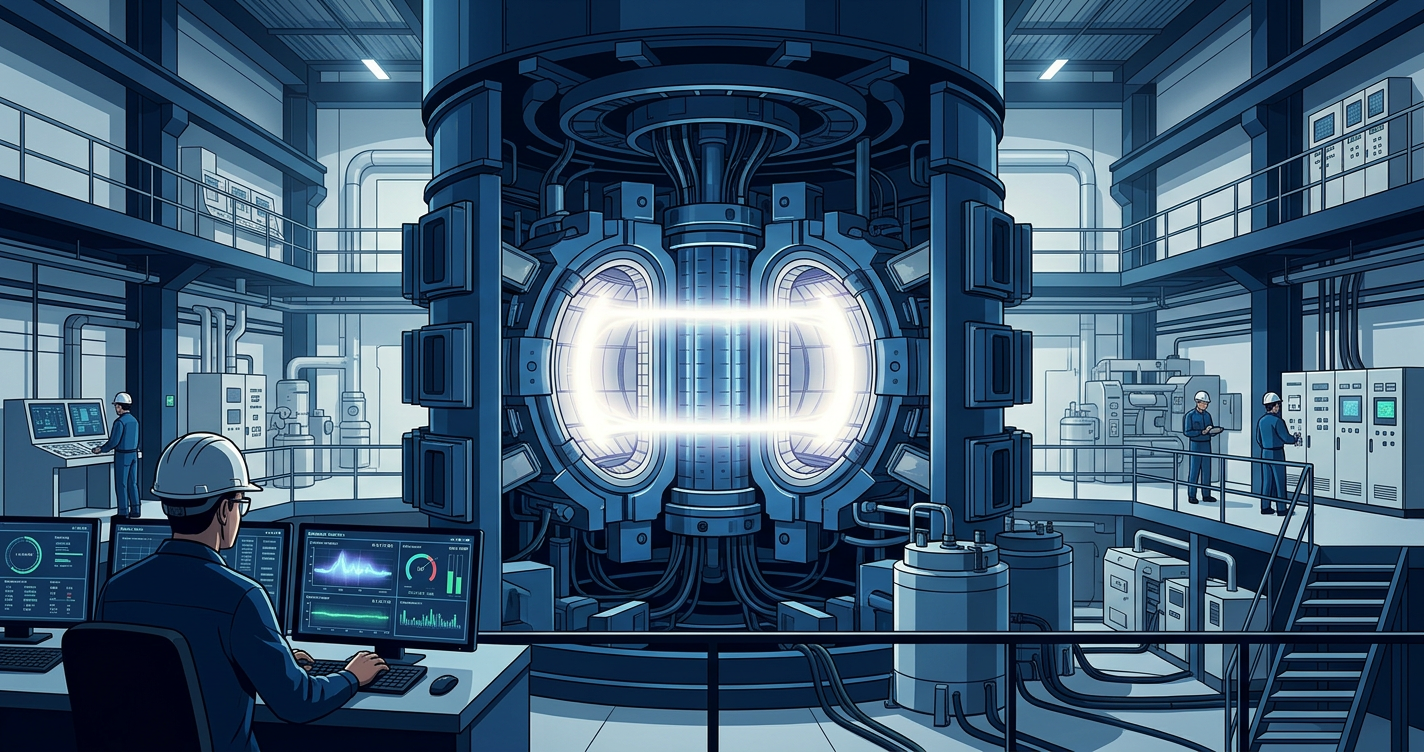
The quest for clean, abundant, and secure energy has always been at the heart of 21st-century challenges. As the energy transition accelerates, a fascinating horizon emerges: that of commercial nuclear fusion by 2026. This technology, long considered a distant dream, is now at a crossroads, promising a nearly limitless source of decarbonized energy.
Nuclear fusion is approaching potential commercialization by 2026, offering a nearly limitless decarbonized energy solution. It represents a major deeptech investment opportunity, with surmountable technological and financial challenges thanks to private innovation, redefining the global energy landscape.
Commercial Nuclear Fusion 2026: The Dawn of Unlimited Alpha Energy
1. The Promise of Nuclear Fusion: An Energy Revolution
Nuclear fusion is the process that powers stars, where light atomic nuclei fuse to form heavier ones, releasing enormous amounts of energy. Unlike current nuclear fission, it uses abundant fuels (derived from seawater), produces no long-lived radioactive waste, and inherently poses a low risk of major accidents. Current enthusiasm is based on significant scientific and technological advancements, making the concept of Commercial Nuclear Fusion 2026 more tangible than ever.
- Abundant fuels: Deuterium and Tritium, extracted from seawater.
- Intrinsic safety: The process stops in case of malfunction; no uncontrolled chain reaction.
- Zero long-term waste: Primarily produces helium, an inert gas.
- Decarbonized energy: No greenhouse gas emissions. Massive investments, particularly in private equity, have catalyzed research and development, accelerating progress towards commercial viability.
2. The Current Landscape: Advances and Key Players
Historically dominated by large-scale public projects like ITER, the race for fusion has seen a multitude of private startups emerge in recent years. These companies, often funded by venture capital and private equity funds, are adopting innovative approaches and disruptive technologies, particularly in high-temperature superconductors, advanced magnetic confinement systems, and artificial intelligence to optimize plasma.
- ITER Project: The world's largest experimental reactor, under construction in France, aiming to prove scientific and technological feasibility.
- Private Startups: Players such as Commonwealth Fusion Systems (CFS), General Fusion, Helion, TAE Technologies, which propose smaller, more agile reactor designs with ambitious market entry timelines.
- Artificial Intelligence (AI): AI plays a crucial role in complex plasma modeling and optimizing reactor performance, reducing development times. These companies are attracting billions of dollars, reflecting growing investor confidence in the maturity of this deeptech. For example, CFS has raised over $2 billion, targeting a reactor demonstrating "breakthrough" (more energy produced than consumed) by 2025.
3. The Deeptech Investment Opportunity for 2026
Investing in commercial nuclear fusion is a bet on the future, but an increasingly calculated one. The potential for returns is immense, as this technology could radically transform the global energy market, estimated at several trillion dollars. For investors, it is a unique opportunity to participate in the creation of a new energy era.
3.1. The Pillars of Investment: Innovation and Exclusivity
Investment in nuclear fusion is a perfect example of alternative investment in disruptive technologies. Companies in the sector develop unique patents and exclusive know-how, creating substantial entry barriers and a sustainable competitive advantage. This specificity makes these assets particularly attractive to specialized funds. This is one of the areas where alternative investment can generate significant "Alpha."
4. Alpha Invest & Securities Perspectives in Fusion
At Alpha Invest & Securities, we are convinced of the transformative potential of Commercial Nuclear Fusion 2026. Our expertise in alternative investment and our continuous monitoring of cutting-edge sectors such as AI, Biotech, and Private Equity ideally position us to identify the most promising opportunities in this field. Our team of experts analyzes technological models, commercialization strategies, and growth potentials to offer you targeted investment vehicles. We already have significant experience in identifying and financing disruptive technologies. For example, areas such as Quantum Internet 2026 or Photonic Chips 2026 are examples of our commitment to financing breakthrough innovation, just like nuclear fusion.
5. Challenges and Risk Mitigation for Commercialization
While promising, the commercialization of nuclear fusion is not without challenges. The main obstacles lie in demonstrating economic viability, industrializing components, and obtaining necessary regulations. However, the modular approach of many startups and the massive injection of private capital are accelerating the resolution of these issues.
- Economic viability: Reducing construction and operating costs of reactors.
- Technological maturity: Achieving sustainable and reproducible performance.
- Regulatory framework: Adapting existing regulations or creating new ones for fusion. Alpha Invest & Securities' approach is to diversify investments within the fusion ecosystem, through companies with complementary technologies and robust management teams, thereby minimizing risks while maximizing return potential. To learn more about our approach, Discover our alternative investment offerings.
| Criterion | Advantage | Potential Level |
|---|---|---|
| Clean energy | Zero CO2 emissions, no long-lived waste | Very High |
| Abundance of resources | Fuels from seawater | Very High |
| Safety | Inherently safe, no risk of meltdown | Very High |
| Potential return | Transformation of the energy market | Exceptional |
| Innovation | Cutting-edge technologies, exclusive patents | High |
- Ignoring the time horizon: Believing that fusion is a reality "tomorrow" or "never." Current advancements indicate an opportunity window by 2026-2030 for the first commercial prototypes.
- Underestimating the impact of private investment: Private startups are more agile and less bureaucratic than government projects, which accelerates R&D.
- Not diversifying your deeptech portfolio: Concentrating all investments on a single fusion technology or a single company without considering the entire ecosystem.
- Learn more: Deepen your understanding of different fusion technologies and key players.
- Evaluate your investment strategy: Consider how deeptech and alternative investments integrate into your overall portfolio.
- Analyze specialized funds: Look for private equity funds or investment vehicles targeting nuclear fusion.
- Contact Alpha Invest & Securities: To discuss your objectives and explore investment opportunities in Commercial Nuclear Fusion 2026 and other future sectors.
- Commonwealth Fusion Systems | https://cfs.energy/
- ITER France | https://www.iter.org/
- International Energy Agency | https://www.iea.org/
- Fusion Industry Association | https://www.fusionindustryassociation.org/
Is commercial nuclear fusion truly possible by 2026? The notion of "commercial" in 2026 often refers to the first pilot or demonstration reactors producing a net energy gain, proving technological and economic viability. Large-scale commercialization would follow in the 2030s. What are the main risks associated with investing in nuclear fusion? Risks include unresolved technological challenges, potential development delays, significant capital requirements, and regulatory uncertainty. Diversification and rigorous selection are key. How can Alpha Invest & Securities help me invest in nuclear fusion? Our expertise in alternative investment and our network in deeptech allow us to identify unique opportunities and structure investment vehicles tailored to your objectives, managing the risks associated with this emerging sector.
✨ Written with SEO Magic AI — Automated SEO Content Generation