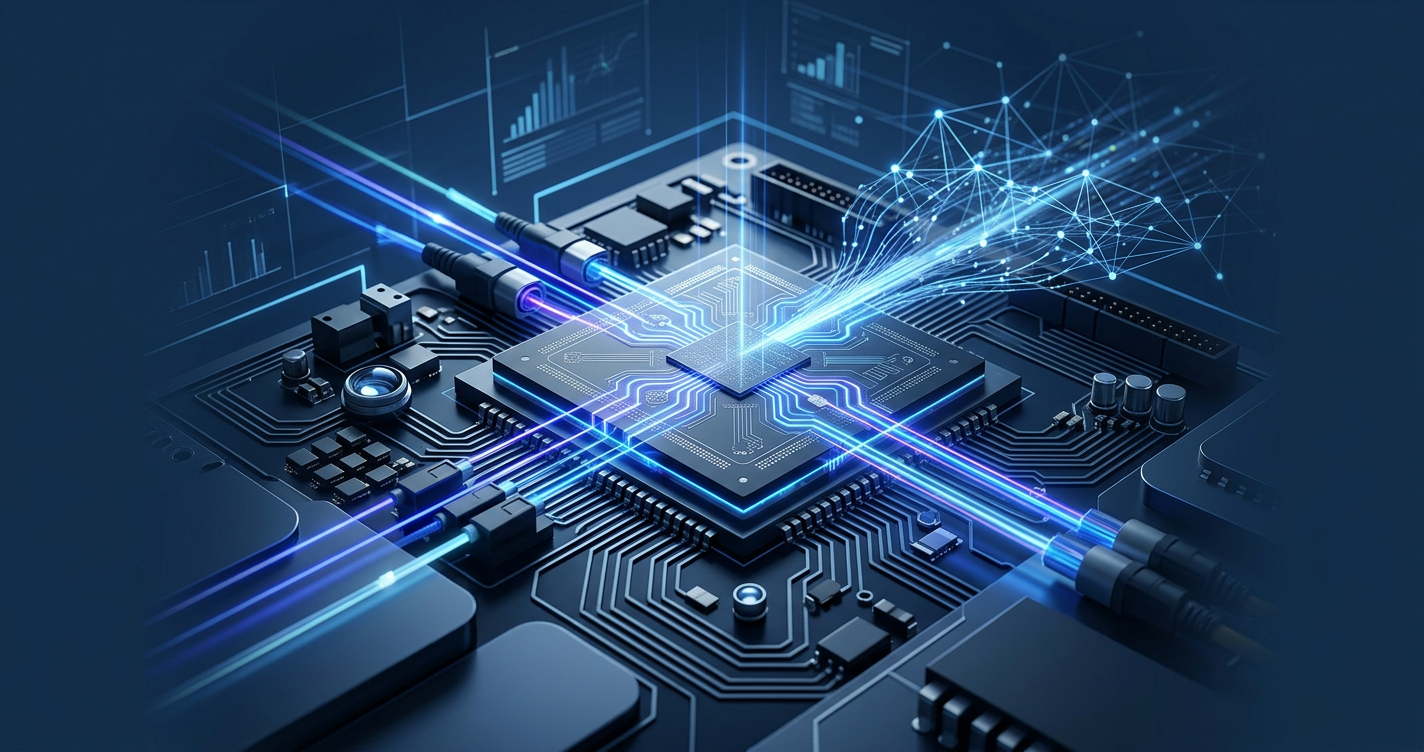
The artificial intelligence sector is booming, but its growth faces physical limitations. 2026 photonic semiconductors are emerging as the essential solution to overcome these constraints. By harnessing the speed of light, these new chips promise a revolution in computing power, offering unprecedented investment opportunities for visionaries.
Photonic (optical) chips will revolutionize AI in 2026 by replacing electrons with photons for ultra-fast and energy-efficient computation. This technology enables major advances in data processing and deep learning, offering crucial investment opportunities in next-gen AI hardware and silicon photonics.
1. The Era of Photonic Chips: A Technological Revolution for AI
Modern computing, based on electrons, is reaching its limits. Current architectures struggle to keep up with the escalating computing needs of artificial intelligence, facing problems of heat dissipation and bandwidth. This is where 2026 AI photonic chips come in, a technology that swaps electrons for photons, particles of light, to transport and process information. The advantages are numerous: unmatched light-speed computing, drastically reduced energy consumption, and massive parallel processing capability. Imagine AI servers consuming fractions of current energy while executing calculations thousands of times faster. According to estimates, optical chips could offer performance gains per watt up to 1,000 times greater than traditional electronic chips. This achievement is a boon for training increasingly complex AI models, from image recognition to advanced natural language systems.
2. How Photonic Semiconductors Work: At the Heart of Innovation
How do these chips work? Rather than using copper wires to route electrical signals, photonic semiconductors employ optical waveguides (similar to fiber optics, but on a nanometric scale) to direct light. Information is encoded in the properties of light (intensity, phase, polarization) and processed by integrated optical components. Silicon photonics is at the center of this breakthrough. It allows the fabrication of optical circuits using existing semiconductor manufacturing techniques, making this technology more accessible and scalable. Operations like wavelength multiplexing enable the simultaneous transmission of multiple data streams over the same light channel, thereby multiplying information transfer capacity. This efficiency is crucial for data centers and data-intensive AI applications.
3. Impact on Artificial Intelligence: Greatly Increased Capabilities
The implications of photonic chips for artificial intelligence are colossal. They will remove current computing bottlenecks, paving the way for major advances in areas such as:
- Deep Learning: The training of complex neural networks will be accelerated, enabling more accurate and sophisticated models.
- Natural Language Processing (NLP): Even more powerful linguistic models, capable of understanding and generating text with near-human fluidity.
- Computer Vision: Faster and more reliable image and video recognition systems, essential for robotics and autonomous vehicles.
- Quantum Computing: While distinct, photonic technologies are also being explored for building qubits and interconnects in quantum computers, creating potential synergies.
- Complex Simulations: The resolution of scientific and engineering problems requiring massive calculations will be radically transformed. With platforms offering computing capabilities in the petaflop range (a thousand trillion operations per second) with unprecedented energy efficiency, next-gen AI hardware is redefining itself. For more information on cutting-edge technologies, feel free to explore our alternative investment offerings.
4. Investment Opportunities in Silicon Photonics
For astute investors, silicon photonics investment represents a major strategic opportunity. The global photonic semiconductor market is expected to reach tens of billions of dollars by 2030, with double-digit annual growth. Key segments to watch include:
- Photonic chip manufacturers: Companies specializing in the design and production of these components.
- Manufacturing equipment suppliers: Companies that develop the machinery necessary for the production of these chips.
- Software and algorithm developers: Those who optimize AI applications to leverage photonic architectures.
- System integrators: Companies that integrate these chips into complete systems for specific applications. Major players in the technology sector are already investing massively, following initiatives like Europe 2026 semiconductors which aim to strengthen the continent's strategic autonomy in this crucial field.
5. Challenges and Future Prospects of AI Optical Chips
Despite its immense potential, the transition to photonic chips is not without challenges. The integration of optical and electronic components on a single chip, aggressive miniaturization, and mastery of physical phenomena at the nanometric scale are technical hurdles. Furthermore, initial R&D costs are high, requiring significant investment. However, rapid progress in research and development suggests that these challenges will be overcome. Long-term prospects include:
- Complete photonic computers.
- Ultra-fast communication networks within the chips themselves.
- Integrated optical sensors for even more advanced AI applications.
- Increased synergy with other emerging technologies such as post-quantum cybersecurity and neurotechnology. 2026 AI optical chips are far more than just an evolution; they represent a fundamental transformation of our ability to process information, opening the door to AI innovations that we can only imagine. To learn more about the future of AI investment, our team of investment experts is at your disposal.
| Criterion | Advantage of Photonic Chips | Impact Level |
|---|---|---|
| Computing Speed | X1000 compared to electronics | Very High |
| Energy Consumption | Drastic reduction (factor 100+) | Very High |
| Bandwidth | Unlimited by interference | High |
| Integration Scale | Compatible with silicon manufacturing | Medium-High |
| Heat Dissipation | Minimal | Very High |
- Common error 1: Ignoring the need to diversify investments: Do not focus solely on one segment of photonics; the market is vast and evolving.
- Common error 2: Underestimating adoption time: While promising, large-scale integration takes time and requires patience.
- Common error 3: Neglecting technical expertise: Investing without understanding the technological basics can lead to poor choices. Seek guidance from specialists.
- Evaluate your portfolio's potential: Identify current assets that could benefit from diversification into breakthrough tech.
- Learn about key players: Analyze leading companies in the research and manufacturing of photonic chips.
- Consult alternative investment experts: Get personalized advice to integrate photonics into your strategy.
- Integrate photonics into your investment strategy: Position yourself in the technologies that will shape the future of AI to maximize returns.
- Yole Development | https://www.yolegroup.com/
- Nature Photonics | https://www.nature.com/nphoton/
- Intel Newsroom | https://www.intel.fr/content/www/fr/fr/newsroom.html
Will photonic chips replace electronic chips? No, it is more likely that they will complement them. The future will probably be hybrid, combining the best of both worlds for optimized computing architectures. What is the main advantage of photonic chips over traditional chips for AI? Light-speed computing and very low energy consumption, allowing much faster and more efficient calculations for complex deep learning and massive data processing tasks. Which sectors will be most impacted by this technology? The AI, high-performance computing (HPC), data centers, telecommunications, healthcare (medical imaging), and defense sectors will greatly benefit from this advance.
✨ Written with SEO Magic AI — Automated SEO Content Generation