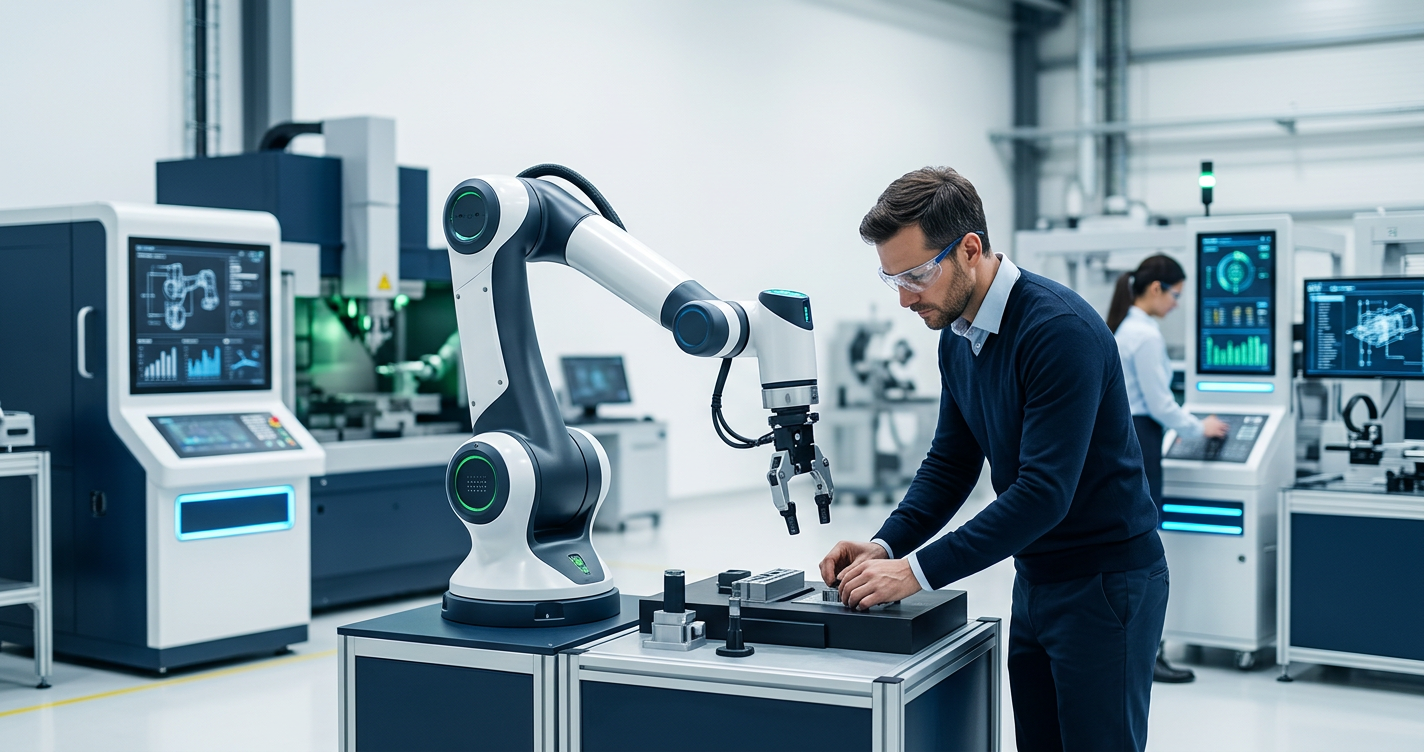
Industry is on the cusp of a major transformation, driven by the emergence of cobots, or collaborative robots. Far from replacing humans, these technologies are redefining the synergy between man and machine, opening up unprecedented opportunities in terms of productivity, innovation, and safety. Alpha Invest & Securities sheds light on this disruptive trend and the opportunities it holds for savvy investors.
Collaborative Robotics 2026 is a major lever for Industry 5.0, optimizing productivity and safety through human-machine collaboration. Investing in cobots offers high potential returns thanks to improved industrial flexibility and efficiency.
Cobotics 2026: Humans and Machines Serving Alpha Industry
Rapid technological evolution, particularly in artificial intelligence and robotics, has led to the advent of cobots. These systems, designed to work alongside human operators without physical safety barriers, are transforming production lines and supply chains. By 2026, the integration of cobots will no longer be an option but an essential component of industrial competitiveness.
1. The Emergence of Collaborative Robotics: A Pillar of Industry 5.0
Collaborative Robotics 2026 represents a significant advance compared to traditional automation. While classic industrial robots are often isolated in safety cages, cobots are equipped with advanced sensors and intelligent software allowing them to interact safely with humans. This characteristic is fundamental for Industry 5.0, a concept that emphasizes customization, sustainability, and resilience, placing humans at the heart of processes.
- Increased safety: Force and vision sensors ensure risk-free interaction.
- Operational flexibility: Easy reprogramming to adapt to different tasks and production volumes.
- Complementary skills: Cobots handle repetitive or physically demanding tasks, freeing humans for higher value-added functions requiring judgment and creativity.
- The cobot market is rapidly expanding. According to recent analyses, it is projected to reach a value of several billion dollars by 2026, with a compound annual growth rate (CAGR) of over 30% over the next five years.
2. Impact on Industrial Productivity and Quality
The integration of cobots results in substantial gains in terms of industrial productivity 2026. By combining the precision and endurance of the machine with the agility and adaptability of the operator, companies can optimize their production processes.
Optimization of Manufacturing Processes
Cobots excel in precision assembly, material handling, quality control, and packaging. They reduce errors, increase production rates, and ensure greater consistency of finished products. For example, in the electronics industry, cobots can perform meticulous soldering or visual inspections with a precision that the human eye struggles to maintain over long periods. These applications are essential for companies aiming for high-quality production and waste reduction. Energy efficiency is also a key factor, as highlighted in our analysis of GaN Chips 2026: Alpha Energy Efficiency Revolution.
3. Cobots in Supply Chain Tech 2026
Beyond manufacturing, cobots play a growing role in Supply Chain Tech 2026. They bring essential automation and flexibility to meet contemporary logistics challenges.
- Order picking: Cobots can assist operators in moving and sorting items, reducing fatigue and increasing processing speed.
- Handling and packaging: They automate repetitive loading, unloading, and packaging tasks, optimizing space and time utilization.
- Inventory: Coupled with vision systems and AI, cobots can perform fast and accurate inventories, minimizing errors and improving traceability.
- These applications contribute to Alpha Invest automation, which aims to be efficient and profitable, especially for demanding sectors.
4. Investment Opportunities in Alpha Invest Automation
For investors, the Collaborative Robotics 2026 sector presents attractive opportunities. Companies that develop, manufacture, or integrate cobots benefit from growing demand.
- Cobot manufacturers: Invest in technological leaders and innovative startups.
- Software developers: AI and control software solutions for cobots are crucial for their performance and adaptability.
- System integrators: Companies that deploy and configure cobots for specific applications are essential to the market.
- Alpha Invest & Securities identifies and analyzes these players to propose targeted investment strategies. We are committed to offering our clients exclusive opportunities in high-growth sectors, as demonstrated by our analyses on Generative AI Biotech. To discover all our services and expertise, do not hesitate to consult our alternative investment offers.
5. Challenges and Future Prospects
Despite immense potential, the deployment of cobots faces certain challenges. The initial investment cost can be a barrier for SMEs, and integration requires specific technical expertise. Furthermore, training human operators to work effectively with cobots is a key success factor. However, continuous advances in AI and robotics promise to overcome these obstacles. Improved user interfaces, reduced costs, and the development of smarter, more autonomous cobots will accelerate their adoption. Collaborative Robotics 2026 is poised to become an industrial standard, facilitating safer, more efficient, and more rewarding work environments for humans.
| Criterion | Cobotics Advantage | Impact Level |
|---|---|---|
| Operator Safety | Reduction of accidents and MSDs (Musculoskeletal Disorders) | High |
| Production Flexibility | Rapid adaptation to product and volume changes | Very High |
| Productivity | Increased rates and reduced downtime | High |
| Product Quality | Error reduction and improved consistency | High |
| Operating Cost | Reduced energy consumption and waste | Moderate |
- Do not evaluate the specific needs of the company before investing in cobots: a poorly adapted deployment can generate unnecessary costs and insufficient return on investment.
- Neglect team training: the integration of cobots must be accompanied by an upskilling of operators to maximize collaboration and acceptance of the technology.
- Underestimate the importance of the software ecosystem: a cobot's performance largely depends on its operating system and its integration capabilities with the company's other digital tools.
- Conduct an audit of your industrial processes to identify repetitive or dangerous tasks eligible for cobot integration.
- Establish a provisional budget including the purchase, integration, and training for a collaborative robotics solution.
- Contact Alpha Invest automation experts for a feasibility study and a customized proposal.
- Plan a pilot project to measure the real impact of cobots on your productivity and the satisfaction of your teams.
- International Federation of Robotics (IFR) | https://ifr.org/
- Universal Robots | https://www.universal-robots.com/fr/
What is the main difference between an industrial robot and a cobot? The main difference lies in collaboration. An industrial robot generally operates autonomously in a secure space separate from humans, whereas a cobot is designed to interact and work safely alongside human operators, without physical barriers. Do cobots replace human jobs? No, cobots are designed to complement and augment human capabilities, rather than replace them. They take on repetitive, dangerous, or physically demanding tasks, allowing human operators to focus on higher-value, creative tasks, or those requiring complex judgment. Which industrial sectors benefit most from cobotics? Cobotics is particularly beneficial for manufacturing sectors (automotive, electronics, consumer goods), logistics, healthcare, and agribusiness, where flexibility, precision, and operator safety are paramount.
✨ Written with SEO Magic AI — Automated SEO content generation