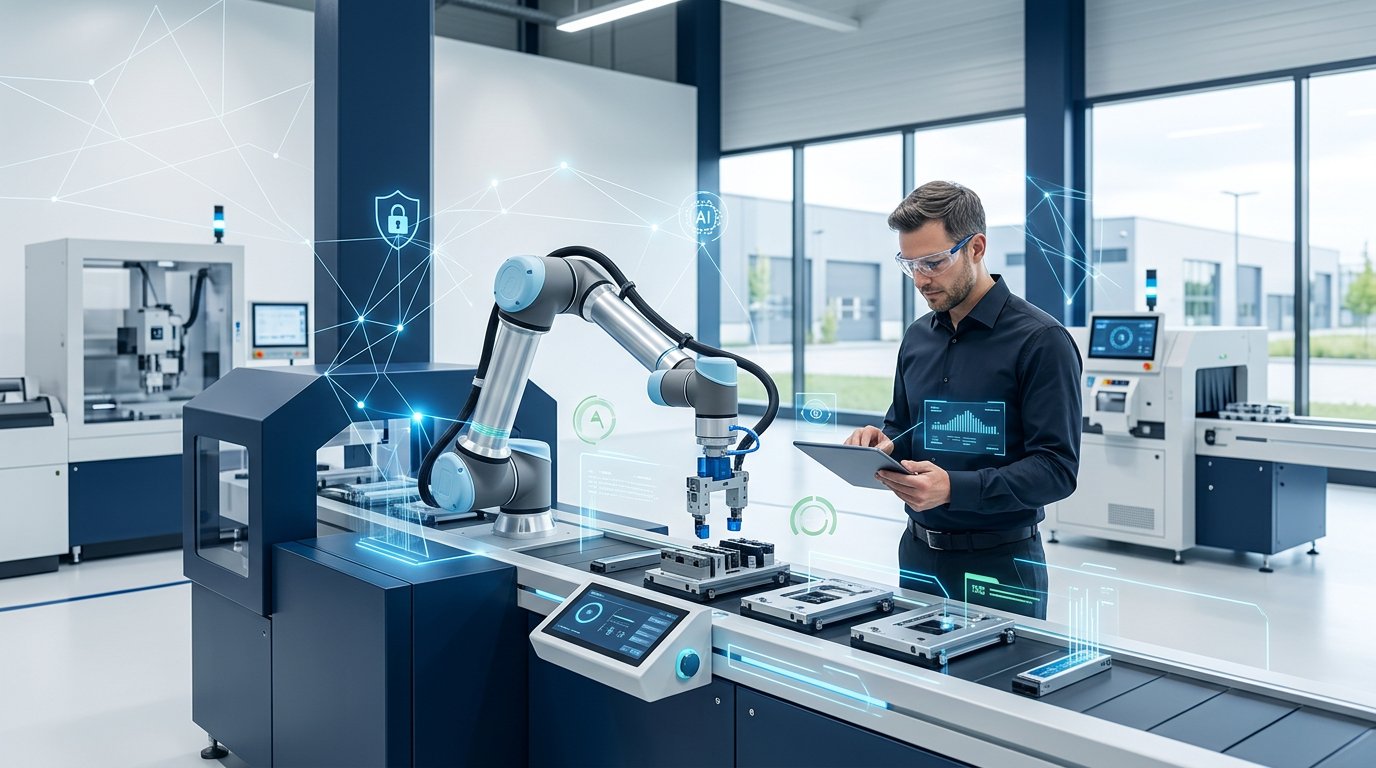
The Industry 4.0 revolution is underway, and industrial cobotics 2026 is a central pillar. Collaborative robots, equipped with artificial intelligence, are redefining European production lines, offering increased productivity and improved working conditions. This article explores the dynamics of this growing market and the opportunities for discerning investors.
Industrial Cobotics 2026 is the key to Industry 4.0 factory automation in Europe, boosting productivity and safety. The adoption of AI collaborative robots will generate 10 billion euros in revenue by 2027, presenting excellent investment opportunities.
1. The Emergence of Cobotics: A Pillar of the Factory of the Future
Industrial cobotics 2026, or the integration of collaborative robots, is much more than a mere technological trend; it represents a profound transformation of the manufacturing sector. Unlike traditional industrial robots, cobots are designed to work alongside human operators, without physical safety barriers, thanks to advanced detection systems and artificial intelligence. This human-machine synergy optimizes processes and improves workstation ergonomics. Europe, with its diverse manufacturing industries, is at the forefront of this adoption. According to analyses, the global cobot market is expected to reach over $8 billion by 2027, with an annual growth of over 20%. This growth is fueled by the need to increase tech manufacturing productivity and address labor challenges. Investors can find promising avenues by exploring innovative companies in this sector, particularly those developing AI collaborative robots.
2. Collaborative Robots and AI: The Alliance of Flexibility and Precision
The integration of artificial intelligence (AI) into collaborative robots is what truly sets them apart. AI allows cobots to learn tasks, adapt to changing environments, and interact more intuitively with humans. For example, machine learning algorithms can be used to optimize cobot trajectories, reduce cycle times, and prevent errors, which directly impacts the bottom line. The applications are vast: precision assembly, pick-and-place, screwing, quality control, logistics, and even more complex tasks in the food processing or pharmaceutical industries. This versatility makes cobots attractive for SMEs and large companies looking to modernize their infrastructure with Industry 4.0 factory automation. Team skills are enhanced, shifting from repetitive tasks to supervision and programming roles. To delve deeper into these technological advancements, feel free to discover our alternative investment offerings, including solutions in artificial intelligence.
3. The Economic Impact in Europe: Figures and Potential
Robotics Europe 2026 is positioned for significant expansion. Investments in industrial cobotics 2026 are driven by government initiatives and private investment funds aimed at strengthening the continent's industrial competitiveness. The figures speak for themselves: Germany, France, and Italy are among the main adopters of cobots, seeking to optimize their value chains. A recent report estimates that the adoption of cobots could generate a productivity gain of 10% to 20% in certain key sectors by 2030, thereby directly contributing to European GDP growth. These gains translate into increased margins for companies and attractive returns on investment for shareholders. It is crucial for investors to closely monitor sectoral developments, particularly in Biotech and Energy, where cobot automation can have a major impact.
4. Challenges and Investment Opportunities in Cobotics
Despite the immense potential of industrial cobotics 2026, challenges remain. One of the main ones is employee training in new technologies and the integration of existing systems with new cobotic solutions. However, these challenges are merely opportunities in disguise for companies offering integration, training, and maintenance services. For investors, the sector offers various approaches:
- Cobot manufacturers: Directly investing in companies that design and produce these collaborative robots.
- AI software developers: Companies specializing in AI algorithms that make cobots smarter and more adaptable.
- System integrators: Companies that help other businesses deploy and manage cobotic solutions.
- Sensor and component suppliers: Opportunities in the supply chain of robotic technologies. Also consider exploring related topics such as "Autonomous Logistics 2026: The Boom in Driverless Infrastructure," which shares synergies with cobotics.
5. Future Prospects and The Role of Alpha Invest & Securities
The future of industrial cobotics 2026 is bright, with continuous advancements in AI, computer vision, and fine manipulation. Collaborative robots will become even more versatile, capable of more complex tasks and more natural human interaction. The market will become increasingly fragmented, with specialized cobots for specific industries, opening new investment niches. At Alpha Invest & Securities, we are committed to identifying these emerging opportunities and making them accessible to our clients. With several years of experience and significant assets under management, we offer unparalleled expertise in alternative investments such as Robotics Europe 2026 hidden gem. Our AMF accreditation ensures rigorous and compliant management. We encourage our clients to consult Our Team of Investment Experts for in-depth analysis.
| Criterion | Advantage | Level |
|---|---|---|
| Market growth | Strong | High |
| Europe adoption | Growing | Moderate+ |
| Return on Invest. | Attractive | High |
| Tech innovation | Dynamic | Very High |
- Do not evaluate the scalability of cobotic solutions: investing in overly rigid systems limits long-term ROI.
- Ignore the importance of staff training: failure of human integration can jeopardize the success of a cobotic project.
- Underestimate hidden costs: maintenance, software updates, and potential infrastructure adjustments.
- Conduct an audit of your operations to identify repetitive and dangerous tasks suitable for cobotics.
- Evaluate cobotic solution providers, prioritizing the integration of AI technologies.
- Plan a budget for training your teams in the use and maintenance of collaborative robots.
- Contact Alpha Invest & Securities to explore investment opportunities in this growing sector, resulting in a diversified and high-performing portfolio.
- International Federation of Robotics (IFR) | https://ifr.org/
- Ministry of Economy, Finance and Recovery | https://www.economie.gouv.fr/
What distinguishes cobots from traditional industrial robots? Cobots, or collaborative robots, are designed to work safely alongside humans without physical barriers, thanks to advanced sensors and AI, unlike industrial robots which operate in separate safety zones. Which industrial sectors are the most promising for cobotics in Europe? The automotive, electronics, agri-food, pharmaceutical, and logistics sectors are among the most advanced in adopting industrial cobotics 2026 solutions in Europe. How does AI improve cobot performance? AI allows cobots to learn complex tasks, adapt to changes in the production environment, optimize their movements, and interact more intuitively with operators, thereby increasing their efficiency and flexibility.
✨ Written with SEO Magic AI — Automated SEO content generation