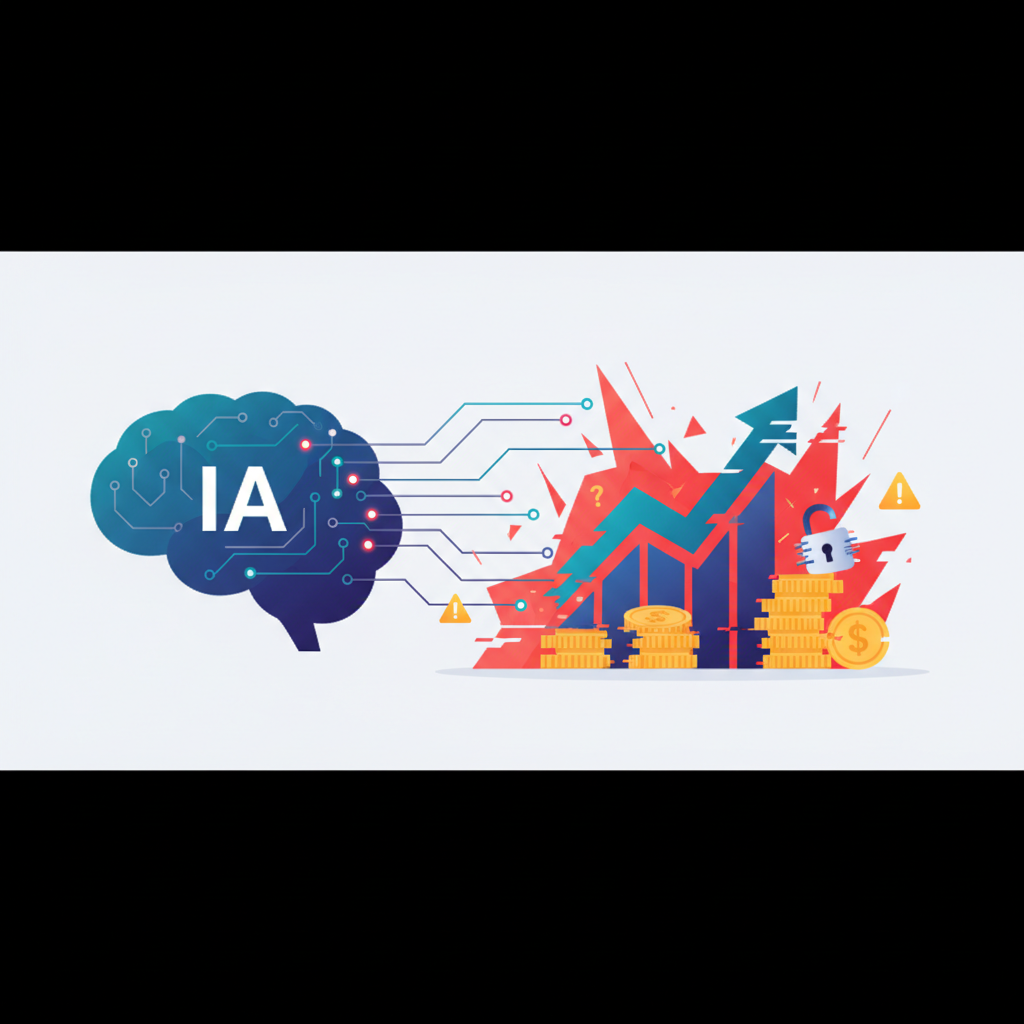
Artificial Intelligence (AI) is revolutionizing many sectors, including finance and investment. While growth opportunities seem limitless, it is crucial to understand the AI investment risks to protect your capital. This detailed article guides you through the most significant challenges and provides strategies for investing wisely in this booming field.
Investing in AI presents significant risks such as algorithmic biases, volatility, and cybersecurity, which can impact the performance of your investments. Rigorous diversification, constant technological monitoring, and understanding regulations are essential to mitigate these dangers and secure your money.
AI Investment Risks: Navigating the Future of Your Investments
Artificial intelligence is undoubtedly one of the driving forces of the global economy. It promises exceptional returns for savvy investors, but it also harbors its share of challenges. Understanding AI investment risks is the first step towards a successful and secure investment strategy.
1. Algorithmic Biases: An Insidious Risk to Your Decisions
AI systems are only as impartial as the data they are trained on. If this data contains historical or societal prejudices, the algorithm will reproduce, or even amplify, these financial algorithmic biases. In investment, this can have disastrous consequences.
- Replication of past errors: An algorithm trained on historical market data may reproduce patterns that, while profitable in the past, are no longer relevant or are even risky in the current environment.
- Implicit discrimination: In security selection or portfolio management, a bias can lead to overvaluing or undervaluing certain assets, sectors, or even types of companies, creating unwanted exposure or missed opportunities.
- Liquidity risk: If several AI systems, all influenced by similar biases, converge on the same trading decisions, this can lead to erratic market movements and increased volatility, particularly during periods of stress. Navigating these algorithmic biases requires constant vigilance and a thorough understanding of the data sources used by AI models.
2. Market Volatility and the AI Hype Cycle
Emerging technologies are inherently subject to high AI volatility. AI is no exception. The "hype" cycle (exaggerated enthusiasm) and disillusionment can lead to extreme value fluctuations, difficult to anticipate.
- Overvaluation of companies: Enthusiasm for AI can push company valuations well beyond their real fundamentals, creating speculative bubbles.
- Dependence on innovation: The value of companies in the AI sector is strongly linked to their ability to innovate and stay at the cutting edge of technology. A delay can lead to a sudden drop in their market capitalization.
- Impact of announcements: Announcements of technological breakthroughs or new regulations can cause disproportionate reactions in the markets, creating sudden peaks and troughs. An AI investment strategy must incorporate a high tolerance for AI volatility or favor a long-term approach, focusing on market leaders and companies with solid foundations.
3. Cybersecurity and Systemic Threats
The increasing integration of AI into financial systems opens new vulnerabilities. AI investment cybersecurity becomes a major concern for both companies and investors.
- Attacks on AI models: Machine learning models can be targeted by data poisoning or evasion attacks, altering their decisions and potentially the integrity of markets.
- Data breaches: The vast quantities of financial data processed by AI increase the risk of sensitive data breaches, leading to financial losses and loss of trust.
- Infrastructure dependency: The failure or compromise of critical AI-based infrastructure could have systemic repercussions, affecting the entire financial markets.
Data Security at the Heart of Concerns
Investing in companies that place cybersecurity at the core of their AI strategy is paramount. Regular audits, encryption, and system resilience are key indicators to monitor.
4. Regulatory Compliance and AI Ethics
The regulatory framework around AI is still evolving. For investors, failing to anticipate changes can lead to significant risks related to AI financial compliance.
- New legislation: Governments and regulatory bodies will inevitably develop laws governing the use of AI, particularly concerning data protection, ethics, and transparency.
- Impact on companies: Companies that do not adapt their practices risk heavy fines, operating bans, or reputational damage, directly impacting their stock market value.
- Ethical questions: The use of AI raises complex ethical questions (fairness, autonomy, responsibility). Poor management of these aspects can lead to public rejection and harm the viability of an investment. Understanding the challenges of AI financial compliance and evaluating companies' ethical strategies is fundamental for sustainable investment.
5. Lack of Transparency and the "Black Box" of Algorithms
Many AI systems, particularly deep learning models, function as "black boxes." It is often difficult to understand how a decision was made, which poses a problem of trust and accountability.
- Audit difficulty: The opacity of algorithmic decisions makes it difficult to audit and verify performance, biases, or errors.
- Ambiguous responsibility: In case of failure or losses, determining responsibility can be complex when the decision emanates from an autonomous system.
- Reduced trust: The lack of transparency can erode investor and public trust in AI-based financial systems, potentially hindering their adoption. The challenge is to find a balance between AI performance and sufficient transparency to ensure trust and accountability.
| Risk Criterion | Potential Impact | Recommended Vigilance Level |
|---|---|---|
| Algorithmic Biases | Loss of opportunity, sub-optimal decisions | High |
| AI Volatility | Extreme price fluctuations, speculative bubbles | High |
| Cybersecurity | Data breaches, system paralysis, fraud | Very High |
| AI Financial Compliance | Fines, operating ban, reputation | High |
| Algorithmic Transparency | Lack of trust, audit difficulty | Moderate to High |
- Blindly investing in "AI" companies without understanding their technology or fundamentals.
- Ignoring the importance of diversification, thinking that AI is a safe bet on its own.
- Failing to inquire about the cybersecurity and data protection policies of the companies you invest in.
- Neglecting the constantly evolving regulatory framework around AI and its impact on businesses.
- Diversify your portfolio: Don't put all your AI eggs in one basket. Include AI companies from different sub-sectors, as well as investments outside of technology.
- Actively research: Deepen your understanding of AI companies' business models, technologies, and risk mitigation strategies before investing.
- Monitor regulations: Stay informed about new laws and directives concerning AI, privacy, and finance in key jurisdictions.
- Adopt a long-term perspective: AI is a transformative technology. Patient and well-informed investors are better positioned to capitalize on its growth.
- Autorité des marchés financiers (AMF) | https://www.amf-france.org/
- European Commission - Artificial Intelligence Regulation | https://digital-strategy.ec.europa.eu/en/policies/artificial-intelligence
- Financial Stability Board (FSB) - Work on AI in Finance | https://www.fsb.org/work-streams/fintech/artificial-intelligence-and-machine-learning-in-finance/
How can I diversify my investment in AI to minimize risks? Diversification can include investing in companies specializing in different areas of AI (software, semiconductors, sectoral applications), as well as AI thematic ETFs or funds that offer exposure to a basket of companies. Don't forget to include non-tech assets in your overall portfolio. Can AI cause a stock market crash? In itself, AI will not cause a crash, but a widespread use of biased or faulty AI models, combined with global market interconnectedness, could exacerbate volatility and trigger deeper recessions. AI volatility due to the hype effect is also a factor to consider. What are the key regulations that apply to AI investments? Key regulations include the General Data Protection Regulation (GDPR) in Europe, future AI laws (like the EU's AI Act), and specific financial regulations that incorporate the use of algorithms and data. AI financial compliance is a rapidly evolving field.