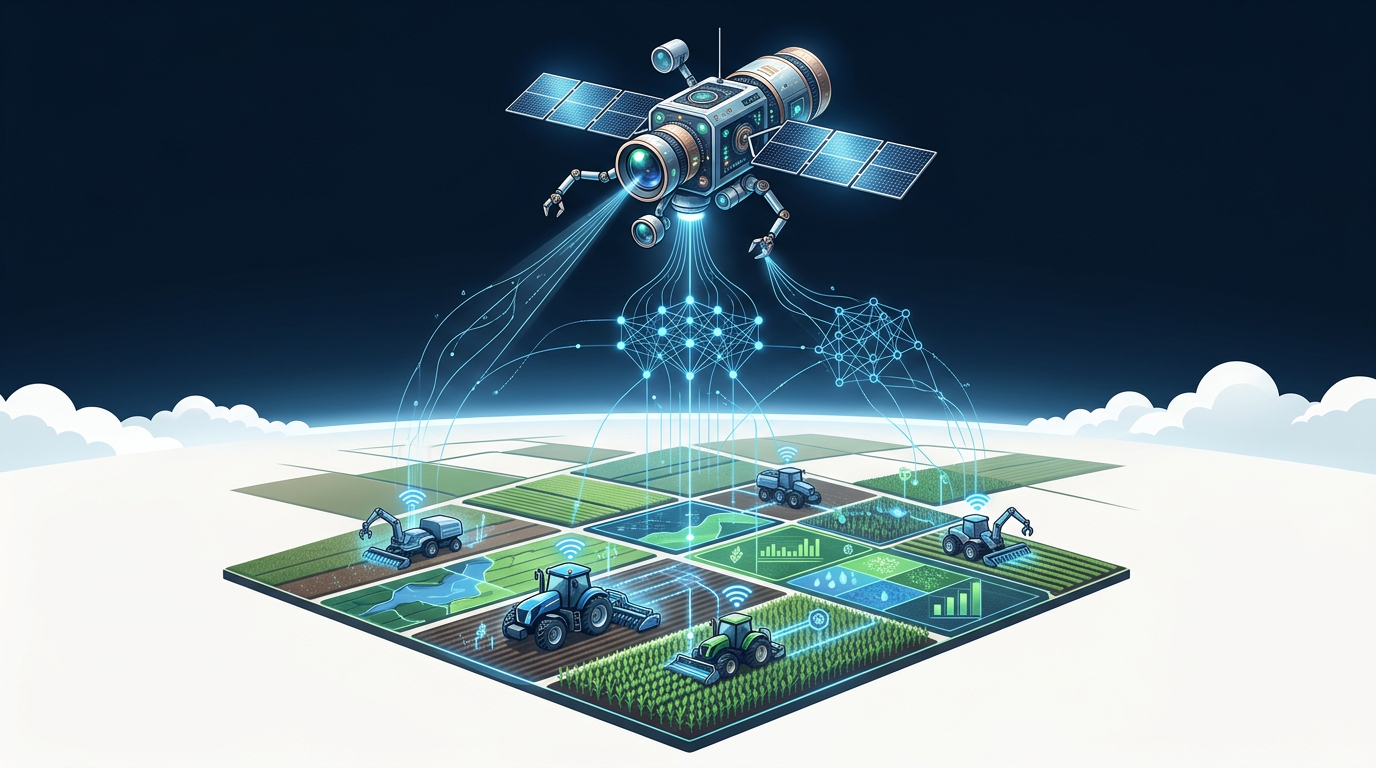
Global agriculture faces unprecedented challenges: increasing production to feed a growing population while minimizing environmental impact. In this context, Space AgTech emerges as a revolutionary solution, promising to optimize every parcel of land thanks to data collected from space. Alpha Invest & Securities invites you to decipher this major trend and its investment opportunities.
Space AgTech leverages agricultural satellite imagery and artificial intelligence for spatial precision agriculture, optimizing crop yields and resource management. This sector offers significant growth and profitability prospects, driven by technological innovation and the need for sustainable agriculture.
Space AgTech 2026: The Future of Agriculture under Alpha Surveillance
Space AgTech represents a strategic convergence between cutting-edge space technologies and the crucial needs of the agricultural sector. By harnessing the power of agricultural satellite imagery, artificial intelligence (AI), and data science, this discipline redefines agricultural practices, moving from plot-level management to hyper-optimized spatial precision agriculture. The stakes are immense: ensuring food security, improving resource efficiency (water, fertilizers), and reducing the ecological footprint.
1. The Revolution of Agricultural Satellite Imagery and AI
Access to precise and near real-time data is the cornerstone of Space AgTech. Satellites equipped with multispectral and hyperspectral sensors collect a myriad of information on crop health, soil composition, moisture levels, and pest infestations.
Data Utilization by Artificial Intelligence
AI plays a central role in analyzing these massive volumes of data. Sophisticated algorithms are capable of:
- Early detection of diseases and water stress: AI identifies anomalies invisible to the naked eye, allowing for targeted interventions.
- Predicting crop yields: By cross-referencing satellite data with climatic and agronomic histories, AI refines forecasts.
- Optimizing irrigation and fertilization: Detailed prescription maps are generated, indicating precisely where and how much input is needed, thereby reducing waste.
- Alpha Climate Monitoring: The integration of spatial weather and climate data makes it possible to anticipate impacts on crops and adapt strategies. According to "The State of AI in Agriculture 2023" report, AI can increase yields by 10 to 20% while reducing water consumption by 20 to 30%. These figures underscore the colossal economic and environmental impact of these technologies.
2. Beyond Imagery: Sensors, Drones, and the Internet of Things (IoT)
While satellites form the foundation of Space AgTech, they are complemented by a host of other technologies for a holistic view. Drones equipped with thermal or multispectral cameras offer finer resolutions for specific areas, while IoT sensors, dispersed in the fields, continuously measure critical parameters at ground level.
Synergy of Technologies for Unrivaled Precision
The integration of these data sources creates a dense information ecosystem:
- Satellites provide a broad overview.
- Drones provide a tactical zoom.
- IoT sensors provide in-situ measurements, validating and refining models. This synergy is essential for effective spatial precision agriculture, enabling farmers to make informed decisions, at the right time and in the right place.
3. The Competitive and Environmental Advantages of Space AgTech
The adoption of Space AgTech provides tangible benefits for farmers and represents an opportunity for investors.
- AI Crop Yield Optimization: Predictive and prescriptive analysis allows for the adaptation of farming practices, maximizing production per hectare.
- Reduction in Operating Costs: Less water, less fertilizer, less pesticides through targeted application, which translates into substantial savings.
- Sustainability and Environmental Impact: More efficient resource use contributes to soil and water preservation, aligning agriculture with sustainable development goals.
- Improved Risk Management: Alpha Climate monitoring and early warning of threats (diseases, drought) help minimize losses. These innovations are part of an optimized agricultural asset management approach, where every decision is supported by reliable data and in-depth analysis. For examples of technological innovation in other sectors, you could explore our article on Cobotics 2026: Collaborative Industrial Revolution Alpha or Generative AI Biotech 2026: Drug Discovery Alpha.
4. Investment Opportunities in Space AgTech 2026
The Space AgTech market is rapidly expanding. It is a key segment of alternative investment that is attracting increasing capital. Investment areas include:
- Startups specializing in satellite data analysis for agriculture.
- Developers of IoT sensors and connectivity solutions for rural areas.
- Drone service companies dedicated to agricultural inspection.
- Private Equity funds targeting innovative players in the AgTech value chain. Alpha Invest & Securities, with its recognized expertise and AMF accreditation, identifies these high-growth potential opportunities. We have already participated in supporting several promising deals in cutting-edge sectors such as Neurotechnology BCI 2026: Investing in Brain-Machine Interfaces Alpha or Commercial Nuclear Fusion 2026: The Dawn of Alpha Energy, and Space AgTech is no exception to our investment vision in innovation.
5. Evolution Perspectives and Future Challenges
Space AgTech is a dynamic sector whose potential is still far from being fully exploited. Continuous innovations in the field of nanosatellite constellations, increasingly powerful AI algorithms, and integration with other technologies (such as blockchain for traceability) promise to further extend its capabilities. However, challenges remain, particularly in terms of the cost of access to data for small farmers, training in new technologies, and regulation. Investment in R&D and inclusive business models will be crucial for widespread adoption. To explore all our investment offerings in these future sectors, do not hesitate to Discover our alternative investment offerings.
| Criterion | Advantage | Level |
|---|---|---|
| Crop Yield | Significant Increase | High |
| Water Consumption | Reduction of 20-30% | High |
| Fertilizer/Pesticide Use | Targeted Optimization | Moderate-High |
| Climate Risk Reduction | Early Warning and Adaptation | High |
| Environmental Sustainability | Overall Improvement | High |
- Ignoring the importance of data integration: An isolated Space AgTech solution without connectivity to other sources (weather, soil sensors, market) will have a limited impact.
- Underestimating the complexity of AI analysis: Without expertise in data science and agronomy, the interpretation of satellite information can be erroneous.
- Neglecting user training: The most advanced technologies are worthless if farmers are not trained to use them effectively to make the right decisions.
- Evaluate the potential of Space AgTech to diversify your alternative investment portfolio.
- Identify leading companies in agricultural satellite imagery and AI for agriculture.
- Schedule a consultation with Our Investment Expert Team to discuss specific opportunities.
- Integrate Space AgTech into your investment strategy for sustainable and innovative returns.
- PwC - AgTech (2022) | https://www.pwc.fr/fr/services/agroalimentaire/agtech-digital.html
- Ministry of Agriculture and Food Sovereignty - The digital modernization of agriculture (2023) | https://agriculture.gouv.fr/la-modernisation-numerique-de-lagriculture
- European Space Agency (ESA) - Earth Observation for Agriculture | https://www.esa.int/Applications/Observing_the_Earth/Agriculture_and_Earth_Observation
What is Space AgTech? Space AgTech refers to the application of space technologies, primarily agricultural satellite imagery and GPS navigation, combined with AI, to optimize agricultural practices, crop management, and resource utilization. What are the main advantages of investing in Space AgTech? Advantages include crop yield optimization, significant reduction in operating costs (water, fertilizers), improved environmental sustainability, better climate risk management, and high market growth potential. Is Space AgTech accessible to small farmers? While initial costs can be a barrier, more and more solutions based on SaaS (Software as a Service) models and shared services are emerging, making Space AgTech more accessible to small and medium-sized farmers.
✨ Written with SEO Magic AI — Automated SEO content generation