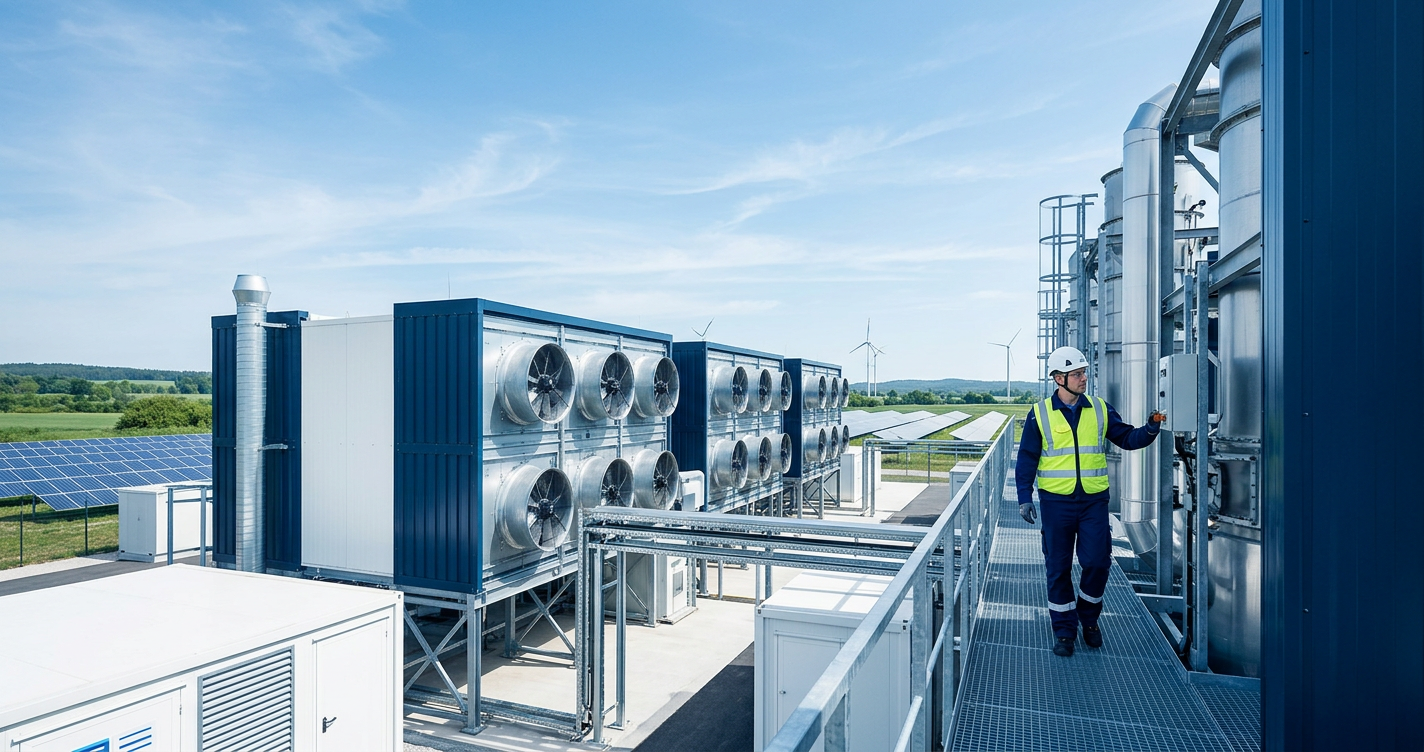
Climate change is one of the most pressing challenges of our time, demanding innovative and bold solutions. Among these, Direct Air Capture (DAC) is emerging as a key technology, capable of extracting carbon dioxide directly from the atmosphere. For savvy investors, 2026 represents a pivotal year to position themselves in this rapidly growing market, offering dual potential: robust financial returns and positive environmental impact.
Direct Air Capture (DAC) is an essential technology for achieving global climate goals and presents major alternative investment opportunities in 2026. Alpha Invest & Securities identifies key players and promising innovations in the sector, offering strategies to capitalize on Alpha Carbon Credits and technological advancements to generate significant returns and contribute to a Net Zero Investment future.
Direct Carbon Capture 2026: Investing in Cleaning the Alpha Sky
Direct Air Capture (DAC) is a cutting-edge technology designed to extract carbon dioxide (CO2) directly from the atmosphere. Unlike point-source capture technologies, DAC does not require concentrated emission sources, making it potentially applicable worldwide. In 2026, this technology is not only mature but also crucial for achieving the carbon neutrality ("Net Zero") goals set by many countries and companies.
1. Understanding the Potential of Direct Air Capture (DAC) in 2026
The DAC market is experiencing exponential growth, driven by government incentives, massive private investments, and a growing awareness of the climate emergency. Projections indicate a need to capture billions of tons of CO2 annually to limit global warming to 1.5°C. DAC, although initially costly, benefits from economies of scale and innovations that are progressively reducing its operational costs.
Market Growth and Projections
The Global Carbon Capture and Storage Institute estimates that global operational DAC capacity could increase from a few thousand tons of CO2 per year to tens or even hundreds of millions of tons by 2030. This surge is fueled by supportive policies such as the 45Q Tax Credit in the United States, which encourages carbon sequestration. In Europe, similar mechanisms and emerging Alpha Carbon Credits markets are stimulating innovation and adoption.
2. Climate Technologies 2026: Innovations and Key Players
Several technological approaches to DAC are under development, each with its advantages and challenges. The main methods include liquid-solvent-based systems and those using solid sorbents.
Emerging Technological Solutions
Liquid-solvent-based systems pass ambient air through chemical solutions that react with CO2 to capture it. Solid sorbents, on the other hand, use porous materials that absorb CO2 at low temperatures and release it at high temperatures to be compressed and stored or used. Advances in Artificial Intelligence (AI) and materials science are accelerating the development of more efficient and less energy-intensive sorbents. The integration of AI is also a key factor in many climate technologies 2026, allowing for process optimization and cost reduction.
Dominant Players and Investment Opportunities
Companies like Climeworks, Carbon Engineering (now 1PointFive), and Global Thermostat are at the forefront of DAC innovation. They are deploying pilot and large-scale plants, attracting significant funding. Investing in these pioneers or in companies that supply essential components (sorbent materials, heat pumps, storage solutions) can offer exceptional growth prospects. Alpha Invest & Securities is committed to identifying these high-potential companies in the alternative investment sector.
3. The Role of Alpha Carbon Credits and Tax Incentives
The economics of DAC are intrinsically linked to the carbon credit market. The ability to monetize captured CO2 via carbon credits is a major lever for the profitability of these projects.
Economic Support Mechanisms
Carbon credits allow companies that emit CO2 to offset their emissions by purchasing credits generated by carbon reduction or sequestration projects. DAC, by offering a direct removal solution, generates high-quality credits, often valued at a premium price. In the United States, the 45Q tax credit has been strengthened, offering up to $180 per ton of CO2 captured and geologically sequestered. Similar mechanisms are developing in Europe and other regions, creating a favorable environment for alternative investments in DAC.
4. Investment Strategies and Potential Returns in DAC
For investors, several avenues are opening up to capitalize on DAC's growth. It's not just about investing in direct operators, but also in the broader ecosystem.
Portfolio Diversification
A balanced portfolio could include:
- Direct investments in listed or unlisted DAC companies.
- Private Equity funds specializing in climate technologies or clean energy. To learn more about this type of approach, discover our alternative investment offers.
- CO2 storage and transport companies, essential to the DAC value chain.
- Innovators in materials and processes, who develop next-generation sorbents or energy solutions for DAC.
- Project developers related to the use of captured CO2 (for example, for the production of synthetic fuels or construction materials). Our team of investment experts continuously analyzes these opportunities for our clients.
5. Future Outlook and Global Environmental Impact
DAC is more than just an investment; it's a commitment to a sustainable future. By supporting this technology, investors actively contribute to the fight against climate change.
Towards Net Zero Investment
The integration of DAC into Net Zero Investment strategies is essential. It is no longer just about reducing emissions, but also about removing them from the atmosphere to offset unavoidable emissions. Alpha Invest & Securities, with its expertise in Private Equity and alternative strategies, supports you in building resilient and high-impact portfolios. Our goal is to transform climate challenges into return opportunities for our clients, ensuring rigorous compliance with regulations and sustainability expectations.
| Criterion | DAC Advantage in 2026 | Level |
|---|---|---|
| Growth Potential | Emerging market with strong political support | High |
| Environmental Impact | Direct contribution to carbon neutrality | Maximal |
| Technological Innovation | Rapid advancements reducing costs and energy consumption | Continuous |
| Carbon Monetization | Stable revenues via high-quality Alpha carbon credits | Medium-High |
| Portfolio Resilience | Diversification of alternative investments | High |
- Common mistake 1 to absolutely avoid: Underestimating the energy cost of DAC. Although innovations reduce this aspect, energy consumption remains a critical factor for profitability. It is essential to invest in solutions with a low energy footprint.
- Common mistake 2 and why: Ignoring the complexity of storing and utilizing captured CO2. Capture is only part of the equation; geological sequestration or CO2 valorization are major logistical and technical challenges not to be overlooked in investment analysis.
- Common mistake 3 with consequences: Not considering the rapid evolution of carbon policies and credit markets. Regulations can change quickly, affecting the value of carbon credits and the profitability of DAC projects. Constant regulatory monitoring is essential.
- First immediate actionable step: Evaluate your current portfolio and identify gaps in alternative investment and sustainability.
- Second concrete step: Contact our specialists for an in-depth analysis of opportunities in climate technologies 2026, particularly DAC.
- Third measurable step: Request a personalized investment proposal integrating DAC solutions, with clear return and impact objectives.
- Fourth step with expected result: Allocate a portion of your capital to promising DAC projects, thereby contributing to both your portfolio's performance and a cleaner future.
- Global CCS Institute | https://www.globalccsinstitute.com/
- International Energy Agency (IEA) | https://www.iea.org/
- Climeworks | https://climeworks.com/
- 1PointFive (Formerly Carbon Engineering) | https://www.1pointfive.com/
What makes Direct Air Capture (DAC) different from other carbon capture technologies? DAC captures CO2 directly from ambient air, unlike point-source capture technologies which focus on emissions from factories or power plants. This makes it more flexible and capable of addressing diffuse emissions. What are the main challenges for large-scale adoption of DAC? The major challenges include the high energy cost of the process, the initial investment cost of facilities, and the need to develop robust infrastructure for the transport and storage of captured CO2. Current innovations aim to reduce these barriers. How can investments in DAC generate financial returns? Returns can come from the sale of high-quality carbon credits generated by CO2 sequestration, partnerships with industries needing CO2 for their products (synthetic fuels, construction materials), and the growth in valuation of pioneering companies in the sector.
✨ Written with SEO Magic AI — Automated SEO content generation